Hazard communication was the second most-cited OSHA standard in fiscal year 2025, behind only fall protection. That is not because exotic chemistry has arrived on construction and telecom sites. It is because the standard covers the ordinary contents of a site van — solvents, adhesives, fuels, cleaning agents, batteries — and most crews have never been told that the drum in the corner comes with a legal right to know what is in it.
The standard changed in 2024, and it changed on a staggered clock. Chemical manufacturers have already had to comply. Employers have not, yet. That date is now close enough to plan around, and it is not the date most compliance calendars still show.
The date that moved
OSHA published the updated Hazard Communication Standard on May 20, 2024, effective July 19, 2024. The rollout was tiered: chemical manufacturers, importers and distributors first, employers behind them, substances before mixtures.
Then, in January 2026, OSHA pushed every compliance date back by four months to give itself time to publish guidance and give everyone else time to read it. So the dates in circulation for the past two years are all wrong by a season.
Here is where it actually stands:
- May 19, 2026 — passed. Chemical manufacturers, importers and distributors had to have substances reclassified, relabelled, and their Safety Data Sheets updated. This is why labels on your shelf may already have changed.
- November 20, 2026. Employers must update workplace labelling, the written hazard communication program, and training, as necessary for newly identified hazards — for substances.
- November 19, 2027. Manufacturers, importers and distributors, for mixtures.
- May 19, 2028. Employers again, for mixtures.
The one with your name on it is the second. Most sites read it as a paperwork date. It is not — it names training explicitly.
What actually changed in the rule
The 2024 rule aligns the standard primarily with Revision 7 of the UN's Globally Harmonized System, the first substantive update since OSHA adopted GHS in 2012. Most of it is classification machinery that matters to chemists. Four changes reach the field.
A new hazard class: desensitized explosives. These are explosive substances wetted or diluted to suppress their explosive properties — stable as supplied, dangerous if they dry out or the phlegmatiser is removed. They carry the flame pictogram. Nothing about them is new in the world; what is new is that they now have to be labelled as their own class rather than filed under something adjacent.
Flammable gases and aerosols were reworked, and chemicals under pressure became their own category under the gas cylinder pictogram. If your site holds aerosol cans of anything — spray adhesive, contact cleaner, marking paint — some of those labels are changing.
Small containers finally have a real rule. Labelling a 50 ml bottle with the full set of GHS elements was never physically possible, and until now the standard offered no relief. The rule now provides flexibility for packages of 100 ml or less, with further allowances at 3 ml or less. It also addresses bulk shipments in tanker trucks, railcars and intermodal containers, and containers already released for shipment when new hazard information arrives.
Safety Data Sheets changed in four sections — 2, 3, 9 and 11. Section 2 now carries particle characteristics for solids, section 3 accepts prescribed concentration ranges when the exact figure is withheld as a trade secret, and sections 9 and 11 were tightened.
One proposal did not survive. OSHA had floated requiring a date of release for shipment printed on every label. It is not in the final rule.
What an employer owes by November 20
The standard asks for three things, and the deadline applies to all of them.
Workplace labelling. Every container in the workplace that is not in its original manufacturer's packaging still needs to identify the chemical and its hazards. Secondary containers — the decanted solvent, the transfer jug, the spray bottle someone filled at the start of the shift — are where sites get cited, because the label problem is created and solved fifty times a day by people who do not think of themselves as handling chemicals.
The written program. A document naming the chemicals present, where the Safety Data Sheets are kept, who maintains them, and how non-routine tasks and contractors are handled. It has to exist on paper or on a screen someone can actually reach, not in a supervisor's head.
Training, as necessary for newly identified hazards. This is the clause that catches people. If a product on your site is reclassified — an aerosol that is now a chemical under pressure, a material now classed as a desensitized explosive — the crew has to be trained on the hazard that label now declares. Training already delivered on the old classification does not cover a hazard that did not exist in the paperwork when it was delivered.
The skill that does not expire: reading a Safety Data Sheet
Classifications change. The document does not. Every hazardous product on a US site comes with a Safety Data Sheet in the same sixteen sections, in the same order, every time:
The fixed order is the whole point. You are not meant to read an SDS. You are meant to be able to open an unfamiliar one and land on what you need in seconds, which is what matters when something has already gone on someone's skin and the label is the only thing anyone knows about the product.
Two details are worth carrying in your head. First, sections 12 through 15 sit with the EPA and the Department of Transportation, not with OSHA. Their headings are mandatory so the format stays consistent internationally, but OSHA does not enforce their content. A thin section 12 is not a defective sheet.
Second, the sheet gets thinner as it gets more useful. Sections 1 through 8 carry everything you need in the first sixty seconds of a problem, and section 8 is where an SDS stops describing the chemical and starts telling you what to put on your hands and face.
Recommended certification
GHS Hazard Communication
$35 · ~1h online · certificate issued same day · valid 2 years
Also read: ANSI/TIA Tower Standards: Preparing Your Company for Compliance · AI-Powered Drone Tower Inspections: Threat or Opportunity for Certified Climbers
Eight pictograms, two words
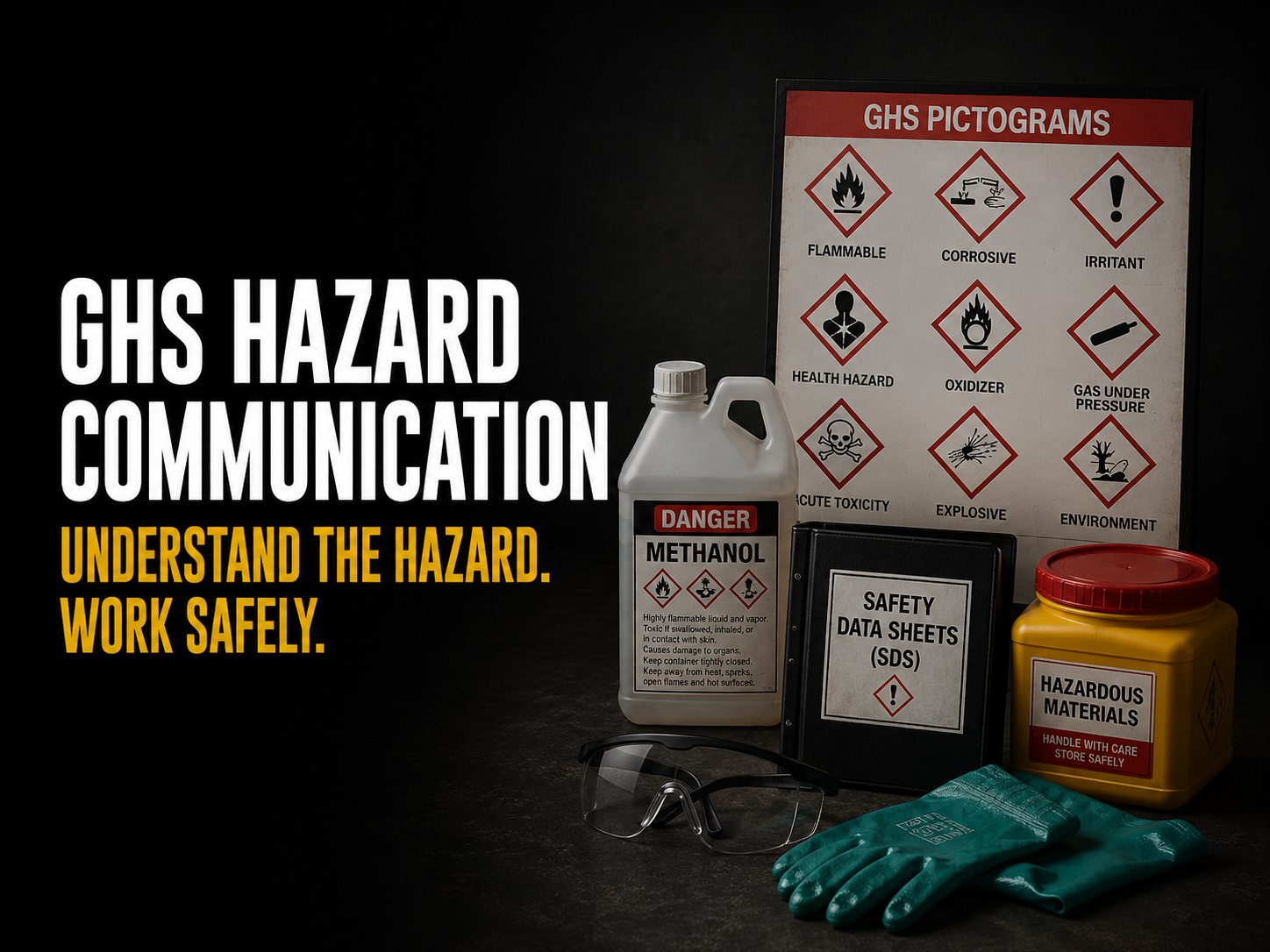
The GHS label carries at most eight pictograms under OSHA — health hazard, flame, exclamation mark, gas cylinder, corrosion, exploding bomb, flame over circle, and skull and crossbones. The ninth, environment, appears on plenty of labels but OSHA does not require it. Each one may appear only once on a label, no matter how many hazards call for it.
Then there are exactly two signal words. Danger is the more severe. Warning is the less severe. There is no third, and there is no scale — a label that says Warning is telling you something specific, not being polite.
That is the entire vocabulary. Eight symbols and two words, and the reason GHS exists at all is so that they mean the same thing on a drum filled in Ohio and one filled in Osaka.
The half no online course can cover
Under the standard, training has two parts, and only one of them is portable.
The universal half is how GHS labels and Safety Data Sheets work — the pictograms, the signal words, the sixteen sections and their order. It transfers between employers and between job sites. That is what the hazard communication and GHS course teaches, and what a certificate can honestly document.
The site-specific half is the chemicals actually present where you work, where the Safety Data Sheets are kept, and your employer's written program. No online course can teach it, because it is different at every site. If a provider implies their certificate alone makes a workplace HazCom compliant, they are describing half the requirement and selling it as the whole thing.
This matters more in November than it usually does. The deadline names training as necessary for newly identified hazards, and "newly identified" is site-specific by definition — it depends on which products on your shelf were reclassified. The universal training gives a crew the vocabulary to understand a changed label. Reading the changed labels on your own site is still your job.
What to do between now and November
Walk the site with the chemical inventory in hand and check the labels against it. Anything aerosol, anything under pressure, anything that arrived in the last year is where the reclassifications will have landed. Pull the Safety Data Sheets for those products and confirm they carry a 2024 or later revision date in section 16 — the manufacturer deadline has passed, so an older sheet on a substance is now worth a call to the supplier.
Then check the two things inspectors reach for first: whether every secondary container on site is labelled, and whether the written program describes the site as it is today rather than as it was when someone wrote it. Both are cheap to fix in August and expensive to explain in December.
Hazard communication is the second most-cited standard in the country because it is the easiest one to be quietly out of compliance with. Nothing about it is dramatic. There is no guard missing and no one working at height. There is just a bottle with no label on it, and a crew that was never told what is inside.