No single OSHA standard requires "cold stress training" by that name — there is no cold-specific OSHA regulation at all, a situation that parallels the current lack of a final federal heat standard. But OSHA's General Duty Clause still applies: an employer whose outdoor crew faces real cold-injury risk from wind chill, wet conditions, or prolonged exposure, with no plan or training in place, is still exposed to a citation for failing to address a recognized hazard.
Why there's no OSHA cold-stress number
OSHA has never issued a standalone cold-stress standard the way it hasn't yet finalized one for heat. There's no regulation number to cite, no mandated wind-chill cutoff, and no required written cold-weather plan tied to a specific OSHA section. That absence isn't a sign cold exposure is considered low-risk — it's simply that cold stress, like heat stress, has been handled through general enforcement tools rather than a dedicated numeric standard.
That means "does OSHA require cold stress training" doesn't have a clean yes answer by regulation number. It has a practical answer instead, and that answer runs through the General Duty Clause.
How the General Duty Clause still creates real exposure
The General Duty Clause (Section 5(a)(1) of the OSH Act) requires employers to keep a workplace free of recognized hazards likely to cause death or serious physical harm. Cold stress — hypothermia, frostbite, reduced grip and coordination at height — is a well-documented hazard in outdoor construction and telecom work, which means it qualifies.
In practice, an employer who sends a crew up a tower or onto a wet jobsite in dangerous wind chill with no cold-weather plan, no warm-up breaks, and no training on recognizing hypothermia or frostbite is exposed to a citation under this clause, even with no numbered cold-stress regulation to point to. The absence of a specific standard is not the same as the absence of liability.
What NIOSH recommends
NIOSH, a research and recommendation agency rather than a regulator, publishes the guidance most employer cold-weather programs are actually built around:
- Layered, dry clothing — wet clothing loses insulating value fast and accelerates heat loss
- Limiting continuous exposure time, with scheduled warm-up breaks in a heated area
- A buddy system, since early hypothermia symptoms (confusion, clumsiness) are easy to miss in yourself
- Training to recognize the early signs of hypothermia and frostbite before they become severe
This guidance isn't legally binding by itself, but it functions as the de facto standard most employers train to, because it's what a reasonable response to a recognized hazard looks like.
Wind chill vs. air temperature
A still 20°F day and a windy 20°F day are not the same hazard, even though the thermometer reads identically. Wind strips heat away from exposed skin far faster than still air does — it's a real, well-documented physical effect, not a minor adjustment. A worker standing on an open tower platform or in an exposed trench in moving wind loses body heat much faster than the same worker sheltered from wind at the same air temperature.
This is exactly why crews need to think in terms of actual conditions at the work location, not just the forecast temperature. Elevated and exposed work — tower climbing, aerial lift work, open-field linework — routinely puts workers directly into wind that ground-level crews nearby don't experience at all.
Who's most at risk on a jobsite
Cold stress risk concentrates wherever workers face extended outdoor, elevated, or wet exposure rather than brief trips outside:
Recommended certification
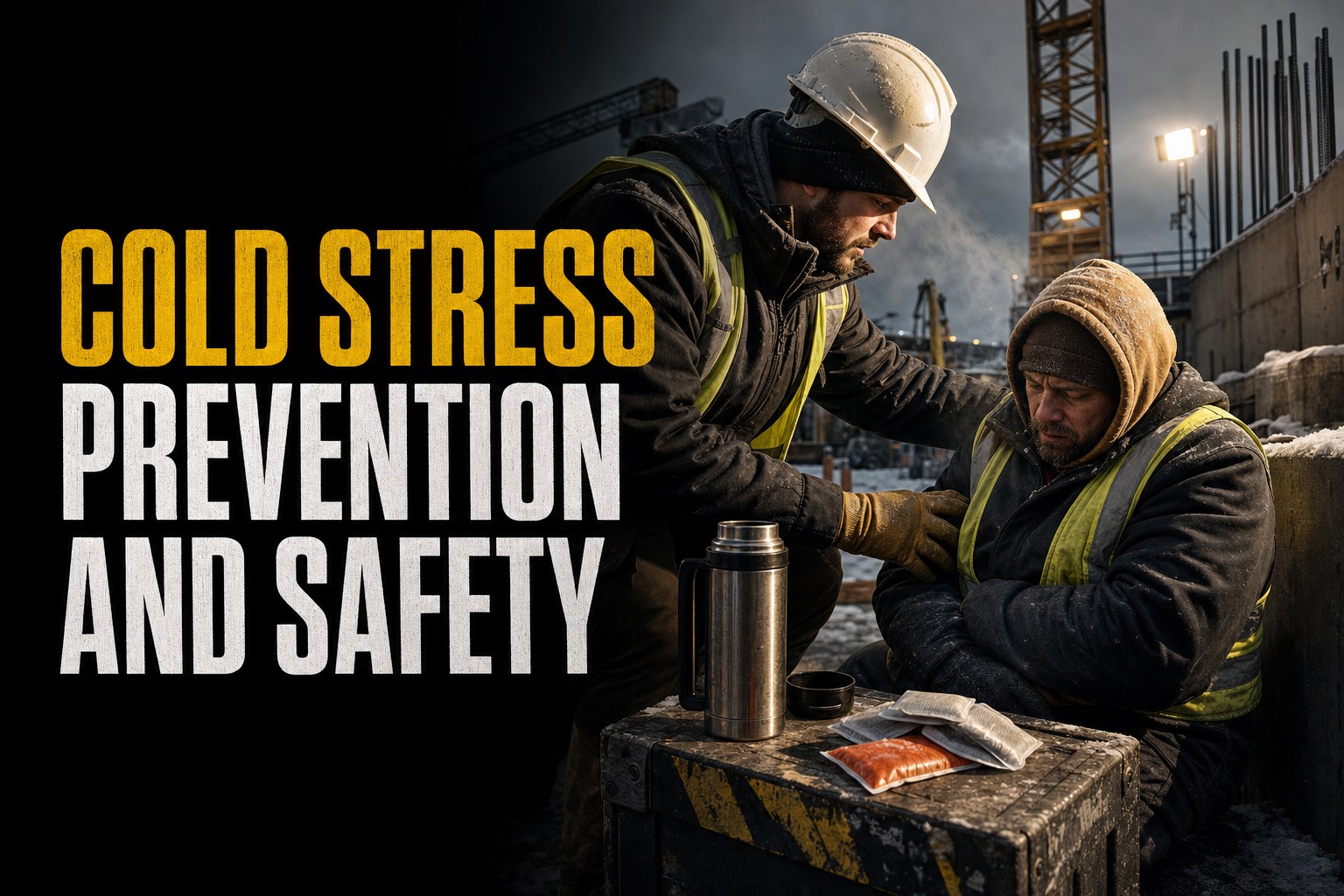
Cold Stress Prevention and Safety
$35 · ~1h online · certificate issued same day · valid 2 years
Also read: ANSI/TIA Tower Standards: Preparing Your Company for Compliance · AI-Powered Drone Tower Inspections: Threat or Opportunity for Certified Climbers
| Role / task | Why the risk is elevated |
| --- | --- |
| Tower climbers | Extended exposure, wind at height, reduced dexterity affecting fall protection use |
| Linework crews | Prolonged outdoor exposure, often with hands exposed for fine work |
| Concrete work in winter | Wet materials and standing water accelerate heat loss |
| Ground crews in open terrain | Sustained wind exposure with no windbreak |
| Anyone working wet or sweat-soaked | Moisture collapses clothing's insulating value |
Cold stress is especially dangerous for elevated and telecom work because reduced hand dexterity and early-stage confusion directly undermine the physical coordination and judgment that fall protection and rigging decisions depend on. That combination — cold-impaired judgment at height — is exactly what our Cold Stress Prevention and Safety course is built to prevent.
Why most employers train for it anyway
Without a numbered regulation forcing the issue, the practical pressure still points the same direction:
Training through Cold Stress Prevention and Safety takes about an hour online and produces a certificate of completion valid for two years, verifiable by its own code — accepted by construction and telecom employers nationwide as standard practice for winter outdoor work.
No numbered standard requires it — General Duty Clause liability and real risk make most employers train for it anyway.
Frequently Asked Questions
Q: Is there an OSHA standard specifically called "cold stress"?
No. OSHA has no cold-specific standard, parallel to the current absence of a final federal heat standard. There's no regulation number, mandated wind-chill cutoff, or required written cold-weather plan tied to a dedicated OSHA section.
Q: Can OSHA still cite an employer for cold-related hazards?
Yes, through the General Duty Clause. If a crew faces real cold-injury risk and the employer has no plan, training, or precautions in place, that can be cited as a failure to address a recognized hazard, even with no numbered cold-stress regulation involved.
Q: Is wind chill actually more dangerous than the same air temperature without wind?
Yes. Wind strips heat from exposed skin much faster than still air at the same temperature. A windy day at a given temperature carries meaningfully more cold-injury risk than a calm day at that same temperature, which is why exposed and elevated work needs extra caution regardless of what the thermometer says.
Q: Who faces the highest cold-stress risk on a jobsite?
Workers with extended outdoor, elevated, or wet exposure — tower climbers, linework crews, and winter concrete work — face the highest risk, both because of prolonged exposure and because cold can impair the dexterity and judgment those tasks depend on.
Q: What does NIOSH recommend for cold-weather work?
Layered, dry clothing, limited continuous exposure with scheduled warm-up breaks, a buddy system, and training to recognize early hypothermia and frostbite signs. NIOSH is a recommendation body, not a regulator, so this guidance isn't independently enforceable, but it's the practical baseline most employer programs follow.
Q: Should a company train on cold stress even without a legal requirement?
Yes. General Duty Clause exposure, real injury risk on elevated and outdoor work, and the liability reduction from a documented program all make training the practical choice regardless of the lack of a numbered standard.