There's no single legal temperature at which outdoor work must stop — OSHA has no final heat standard (see our companion article on OSHA's heat-stress rulemaking status). Instead, NIOSH recommends tracking the heat index rather than raw air temperature, and scaling up water, rest, and shade as it climbs — with real caution warranted once the heat index reaches the low-to-mid 90s°F and serious caution as it climbs further, adjusted for how hard the work is and whether workers are acclimatized.
Why temperature alone is the wrong number to watch
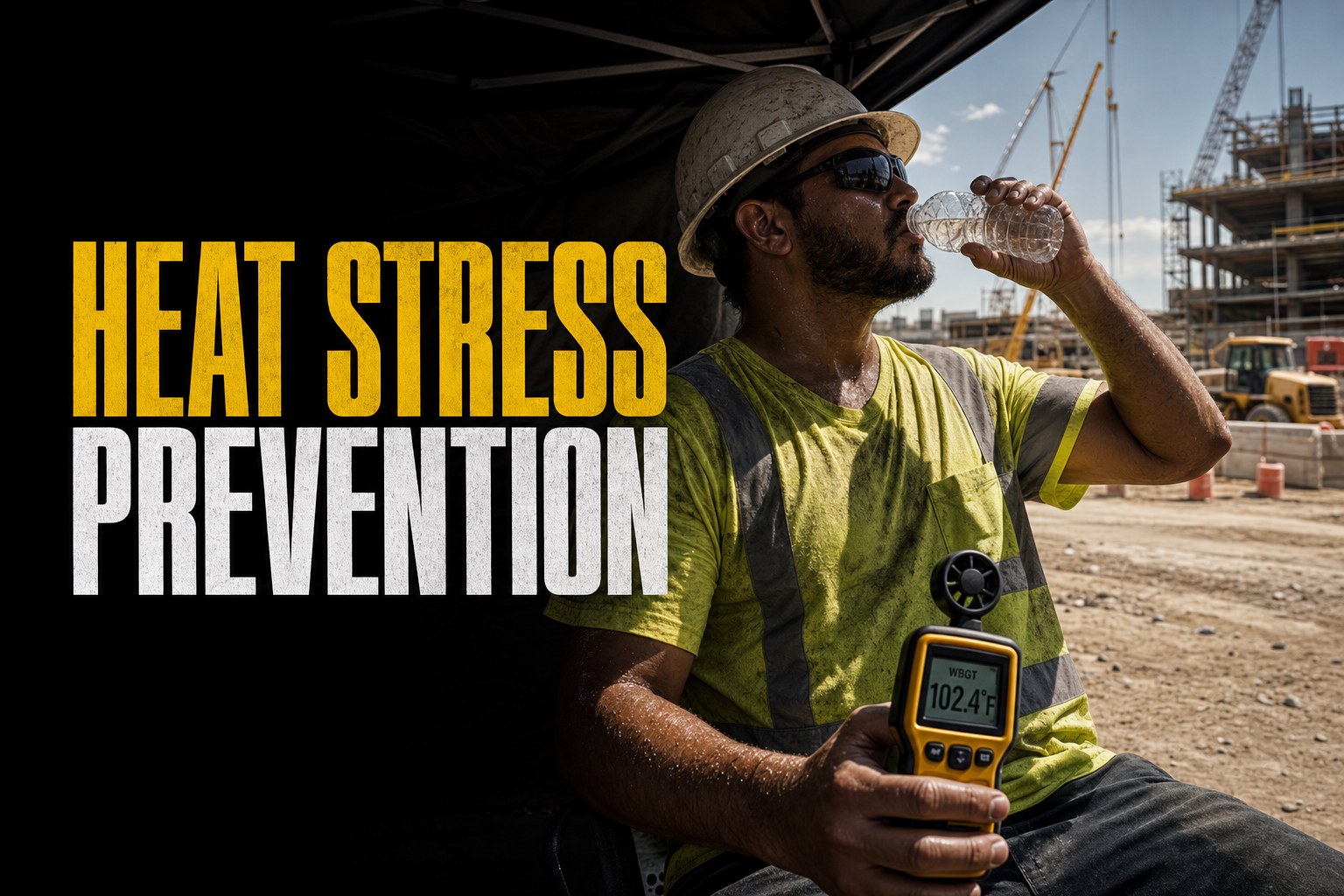
Air temperature only tells you half the story. Humidity is what determines how well your body can actually cool itself through sweat evaporation — a muggy 88°F afternoon can load more heat stress onto a working body than a dry 95°F day. That combined effect is what the heat index measures: what the air actually feels like to a body trying to shed heat, not just what the thermometer reads.
This is why a crew that only watches the forecasted temperature can get caught off guard. Two days with the identical air temperature can carry very different real risk depending on humidity, sun exposure, and how much physical work is happening. Heat Stress Prevention training spends real time on this distinction because it's the single most common misunderstanding on a jobsite.
How risk scales as the heat index climbs
There's no official federal numeric chart requiring specific actions at specific heat-index values — that kind of binding table doesn't currently exist at the federal level. But the general pattern NIOSH-style guidance follows is consistent and worth internalizing:
- As the heat index climbs into the low-to-mid 90s°F, that's the point to start taking real precautions — more frequent water breaks, available shade, and closer attention to how the crew is holding up.
- As it climbs further, toward the low 100s°F and beyond, caution needs to get more serious — shorter work/rest cycles, mandatory shade breaks, and active buddy-system monitoring rather than just availability of water and shade.
- Heavier physical exertion (digging, climbing, carrying loads) pushes the effective risk up faster than light work at the same heat index, so workload matters as much as the number on the chart.
- Direct sun exposure, lack of air movement, and heavy or non-breathable PPE all add real heat load on top of the ambient heat index.
The practical takeaway: treat the heat index as a dial, not a switch. Risk rises continuously as it climbs, and the right response is to scale up breaks, shade, and hydration proportionally — not wait for a single trigger number before doing anything.
Acclimatization: why the first hot days are the most dangerous
A worker's body adapts to heat over time — sweat rate, electrolyte balance, and cardiovascular efficiency all improve with repeated heat exposure. That adaptation takes roughly one to two weeks of gradually increasing exposure, and it's exactly what's missing on a crew member's first hot days of the season, after time off, or after a transfer from a cooler climate.
This is why a disproportionate share of serious heat illness cases happen in the first few days of a heat wave or a worker's first week back on a hot job, not in the middle of a long stretch everyone's used to. The practical fix isn't a hard number — it's a schedule: start new or returning workers at a lighter workload and shorter exposure time, and build up over about a week to two weeks rather than putting them straight into a full shift at full pace.
| Exposure stage | Recommended approach |
| --- | --- |
| Day 1–2 (new or returning worker) | Reduced workload/duration, frequent check-ins |
| Day 3–5 | Gradually increase to near-normal workload |
| Week 2 | Full workload with standard monitoring |
| Any worker after illness, injury, or time off | Restart acclimatization schedule |
Recognizing heat exhaustion vs. heat stroke early
These two conditions look different and require different urgency, and every crew member should be able to tell them apart without hesitating:
Heat exhaustion shows up as heavy sweating, weakness, dizziness, headache, and nausea. The skin is usually still cool and clammy. This needs an immediate break in shade or cooling, water, and close monitoring — it can resolve with prompt action.
Recommended certification
Heat Stress Prevention
$30 · ~1h online · certificate issued same day · valid 2 years
Also read: ANSI/TIA Tower Standards: Preparing Your Company for Compliance · AI-Powered Drone Tower Inspections: Threat or Opportunity for Certified Climbers
Heat stroke is a medical emergency. Warning signs include hot, dry skin (or sometimes still sweaty), confusion, slurred speech, or loss of consciousness. If someone shows these signs, call 911 immediately and begin cooling them while waiting for help — do not wait to see if it passes.
The line between the two can blur fast, which is the real danger. Heat Stress Prevention training walks crews through exactly what to watch for and what to do in the first minutes, because the gap between "heat exhaustion treated promptly" and "heat stroke untreated" is often just a few unmonitored minutes.
What a sensible crew does on a hot day, mandate or not
Even without a legal numeric trigger, there's a practical baseline that costs little and prevents real incidents:
Our Heat Stress Prevention training builds all of this into a practical, scenario-based course — about an hour online, with a certificate valid for two years. It's the fastest way to get an entire crew speaking the same language about heat risk before the next hot stretch hits, and it's built directly around how real construction and telecom crews are actually exposed to heat on the job, not generic indoor-office advice.
Watch the heat index, not the thermometer — humidity is half the real risk.
Frequently Asked Questions
Q: Is there an official temperature where OSHA requires work to stop?
No. OSHA does not currently have a final heat standard with a numeric stop-work trigger. The practical guidance that exists — largely from NIOSH — is based on the heat index, not a fixed stop/start temperature, and scales precautions up gradually as conditions worsen.
Q: What's the difference between air temperature and heat index?
Air temperature is just what a thermometer reads. Heat index combines temperature and humidity to estimate what the air actually feels like to a body trying to cool itself through sweat — which is the number that actually reflects real heat stress risk.
Q: How long does it take to acclimatize to working in heat?
Roughly one to two weeks of gradually increasing heat exposure, starting with reduced workload and duration and building up to normal pace. Workers returning from time off, illness, or a cooler climate need to restart this process.
Q: What are the early warning signs of heat exhaustion?
Heavy sweating, weakness, dizziness, headache, and nausea, usually with skin that's still cool and clammy. It requires an immediate break in shade, water, and monitoring, and typically improves with prompt action.
Q: How is heat stroke different, and what should I do?
Heat stroke involves confusion, slurred speech, hot and often dry skin, or loss of consciousness. It is a medical emergency — call 911 immediately and begin cooling the person while waiting for help. Do not wait to see if symptoms pass on their own.
Q: Does humidity really matter that much compared to temperature?
Yes. A humid day in the high 80s°F can carry more real heat stress risk than a dry day in the mid-90s°F, because high humidity slows sweat evaporation, which is the body's main cooling mechanism. That's exactly why the heat index, not raw temperature, is the number worth tracking.