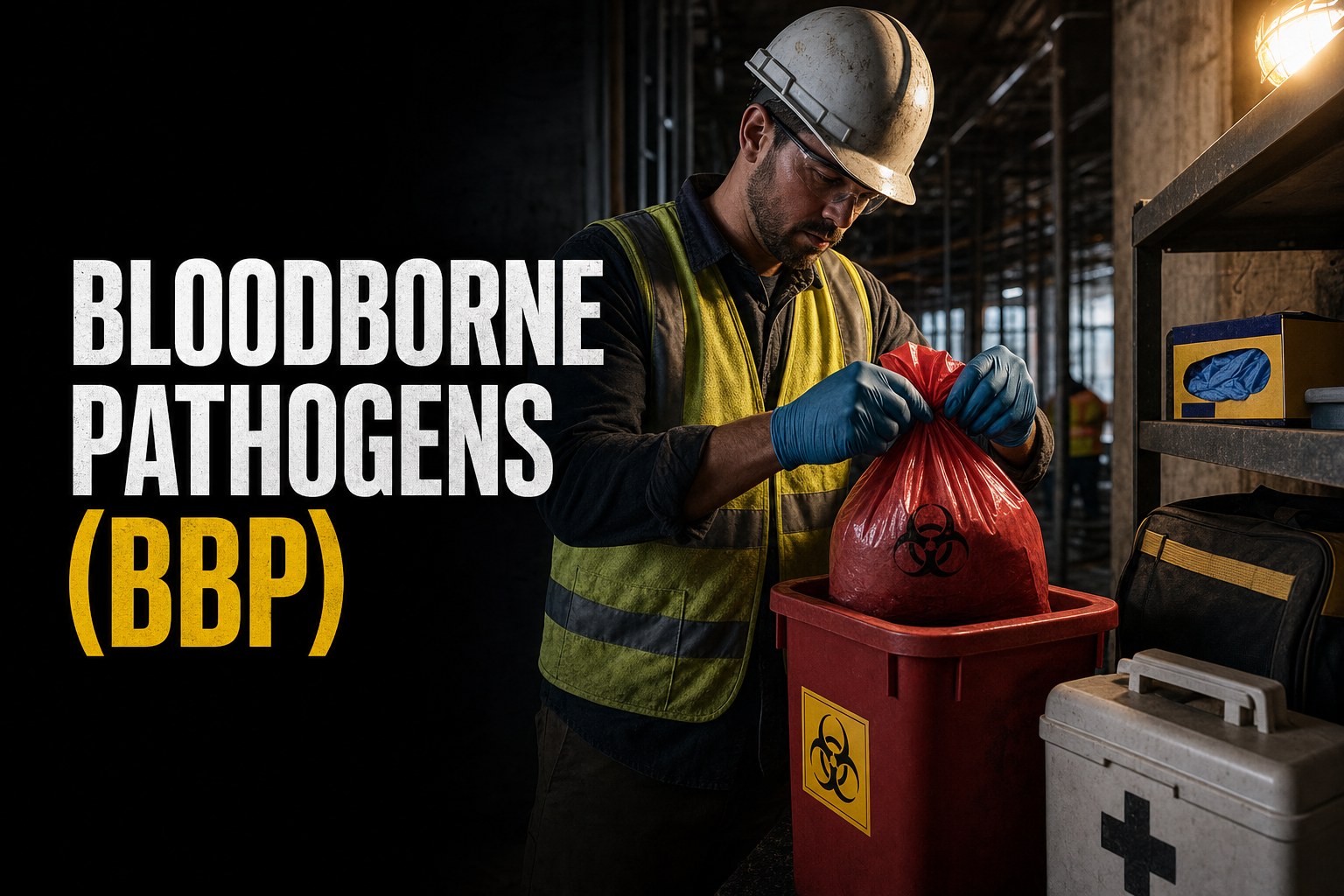
Under 29 CFR 1910.1030, bloodborne pathogens training is required for any employee with "occupational exposure" — reasonably anticipated contact with blood or other potentially infectious materials (OPIM) as part of their job duties. That is not limited to healthcare workers: on a construction or telecom site, it covers designated first-aid responders, anyone tasked with cleaning up after an injury, and crews who handle contaminated PPE or sharps. Training has to happen before someone is assigned exposure-risk duties, and again every 12 months after that.
Most crews lump this in with CPR or first-aid training and assume one card covers both. It doesn't — they're two separate OSHA requirements with different triggers, and a site can pass a first-aid audit and still fail a bloodborne pathogens one.
Who Exactly Has "Occupational Exposure"
OSHA's test isn't your job title — it's whether your duties make contact with blood or OPIM reasonably anticipated, not just theoretically possible. In practice that usually means:
- Anyone designated as a site first responder or "the person who handles injuries"
- Crew members assigned to clean up after a cut, needle stick, or blood spill
- Anyone who launders, bags, or disposes of contaminated PPE, rags, or dressings
- Safety managers who investigate or document exposure incidents
A worker who might give first aid in a true emergency, with no assigned duty to do so, usually falls outside the standard's exposure determination — but once someone is designated or routinely does this work, the training and the rest of 1910.1030's protections (hepatitis B vaccination offer, exposure control plan, PPE) kick in.
Recommended certification
Standard – CPR / AED / First Aid
$40 · ~1h online · certificate issued same day · valid 2 years
Also read: ANSI/TIA Tower Standards: Preparing Your Company for Compliance · AI-Powered Drone Tower Inspections: Threat or Opportunity for Certified Climbers
What the Training Has to Cover
1910.1030 lists specific content the training must include, not just "watch a video about germs":
- How bloodborne pathogens (HBV, HCV, HIV) are transmitted, and the modes that matter on a job site
- The employer's written exposure control plan and where to find it
- Tasks that may involve exposure, and the PPE assigned to each
- Correct use, limits, and disposal of PPE and sharps
- What to do immediately after an exposure incident, and who to report it to
- The hepatitis B vaccination — that it is offered free of charge, and why
Bloodborne Pathogens Training vs. Standard First Aid / CPR
| | Bloodborne Pathogens (1910.1030) | CPR / First Aid / AED |
|---|---|---|
| Triggers training | Reasonably anticipated contact with blood/OPIM | Designated responder role, general preparedness |
| Core content | Exposure control plan, PPE, post-exposure steps, HBV vaccine | Compressions, rescue breaths, AED use, wound care |
| Renewal | Annually | Typically every 2 years |
| Covers "what to do after I'm exposed to someone's blood" | Yes | No |
| Covers "how to keep someone breathing until EMS arrives" | No | Yes |
Most crews need both, and BuildRight's Standard – CPR/AED/First Aid course is the natural pair for this one — they're sold and taken separately because OSHA requires them separately.
After an Exposure Incident
OSHA requires a specific sequence: immediate first aid, confidential medical evaluation and follow-up at no cost to the employee, and documentation in the exposure control plan. Training has to leave people knowing who to report to on their own site — not just that reporting is required. A worker who doesn't know the reporting chain before an exposure happens is the most common gap an inspector finds.
Who Decides If You Need This, and How Often
The employer makes the exposure determination, based on job duties, not job title — the same logic used for OSHA's "qualified person" designations elsewhere (electrical, rigging). Once someone is designated, annual retraining is mandatory regardless of whether an exposure incident actually happened that year.
What the Course Covers
BuildRight's Bloodborne Pathogens (BBP) course ($15, about 1 hour) covers transmission modes, the exposure control plan, correct PPE use and disposal, the post-exposure reporting sequence, and the hepatitis B vaccination requirement — built to OSHA 1910.1030. It finishes with a final test and a certificate of completion. Many crews take it alongside Standard – CPR/AED/First Aid to cover both the exposure-control and emergency-response sides of site first aid in one sitting.
Frequently Asked Questions
Does every construction worker need bloodborne pathogens training?
No — only employees with occupational exposure as determined by the employer: designated first responders, cleanup crews, and anyone who routinely handles contaminated materials. A general laborer with no such duty typically isn't covered, though many employers train broadly anyway.
Is a BBP certificate the same as a first-aid certificate?
No. They're two separate OSHA training requirements with different required content and different renewal schedules. Most sites that need one need both.
How often does bloodborne pathogens training need to be renewed?
Annually, under 1910.1030 — regardless of whether anyone actually had an exposure incident during the year.
Does my employer have to offer the hepatitis B vaccine?
Yes, to anyone with occupational exposure, at no cost, within 10 working days of initial assignment — the training has to tell employees this is their right, even if they choose to decline it.
What should I do immediately after a needle stick or blood exposure?
Wash the area immediately, report it to your supervisor right away, and follow your site's exposure control plan for medical evaluation — the course covers the full reporting sequence so you know it before you need it, not after.