Crane Hand Signals Trainer
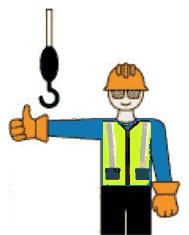
The operator does not get a second look at your hands. The picture comes up, you call the signal — all 19 from the standard chart, shuffled every run. Miss one and you get the official description of the motion, then it comes back next time.
Name the signal
Call the signal
Questions crews ask
How many standard crane hand signals are there?
Nineteen. The Standard Method chart — Appendix A to 29 CFR 1926 Subpart CC, which 1926.1419(c) makes mandatory for hand signals — covers stop, emergency stop, dog everything, hoist and lower, raise and lower boom, the two combined boom-and-load signals, extend and retract a telescoping boom, swing, travel, trolley travel, both crawler travel signals, move slowly, and the two signals that switch between main hoist and whipline. This drill runs all nineteen.
Does OSHA require hand signals specifically?
No — 1926.1419(b) allows hand, voice, audible or new signals, and the method has to suit the site. But once hand signals are used, 1926.1419(c) requires the Standard Method chart — no advance agreement needed, everyone is expected to know it. Only non-standard hand signals, allowed where the standard ones are infeasible or don't cover the operation, must be agreed between the signal person, operator and lift director before the lift. And 1926.1422 requires the chart to be posted on the equipment or near the lift. That is why recognition matters: an improvised signal that only one person understands is the failure mode.
Who is allowed to give signals to a crane operator?
A qualified signal person. Under 1926.1428 that means someone who knows and can demonstrate the signals, understands crane operation and its limitations, knows the relevant requirements of subpart CC, and has passed both an oral or written test and a practical test. An employer or a third-party evaluator documents that qualification — passing a drill like this one is practice, not qualification.
What is the difference between "stop" and "dog everything"?
Stop halts the motion in progress: arm out, palm down, swinging back and forth. Emergency stop uses both arms the same way and means halt now. Dog everything — hands clasped in front of the body — tells the operator to hold everything where it is and stand by, which is what you use when work has to pause with a load in the air rather than when something has gone wrong.
Why is "move slowly" given with two hands?
Because it is a modifier, not a command. One hand gives the ordinary motion signal — hoist, swing, whatever the lift needs — and the other hand is held motionless in front of it. The operator reads the motion from the moving hand and the speed from the still one. It is the signal that gets skipped most and matters most when the load is near people or steel.
Take it past the drill
The drill is practice, not qualification. A signal person is qualified under 29 CFR 1926.1428 by an employer or third-party evaluator, through an oral or written test and a practical test. Signal descriptions here follow the ASME B30.5 chart referenced by 1926.1422.