They cover different worksites. 29 CFR 1910.147, "The control of hazardous energy (lockout/tagout)," is OSHA's general-industry standard — and it explicitly excludes construction: 1910.147(a)(1)(ii)(A) states the standard "does not cover... Construction and agriculture employment." Construction sites control hazardous energy instead through standard-specific requirements spread across different parts of 29 CFR 1926, rather than one consolidated LOTO regulation. BuildRight sells two separate courses because the two situations genuinely call for different training, not because of overlapping marketing names.
Why Two Courses With Similar-Sounding Names
"Lockout/tagout" and "control of hazardous energy" sound like the same idea said two ways, and conceptually they are — both are about making sure stored or active energy can't unexpectedly injure someone servicing equipment. But which regulation actually governs the work depends entirely on whether it's general industry or construction, and the two have different rules, different documentation expectations, and — on a construction site — no single standard to point to the way 1910.147 provides for general industry.
What 1910.147 (General Industry LOTO) Actually Requires
This is the "classic" LOTO program most people picture: servicing or maintaining machines and equipment where unexpected energization or stored-energy release could injure someone. The core elements:
- Identify every energy source — electrical, hydraulic, pneumatic, thermal, gravity
- Shut down equipment using its normal stopping procedure
- Isolate and apply a personal lock and tag to each energy-isolating device
- Release or block stored energy (bleed lines, discharge capacitors, block elevated parts)
- Verify a zero-energy state before work begins
- One worker, one lock, one key — only the person who applied a lock removes it
This program is built for manufacturing-type servicing and maintenance work — the equipment, process, and energy sources are generally fixed and well-defined.
Why 1910.147 Doesn't Apply to Construction
This isn't an interpretation — it's the regulation's own scope section. 1910.147(a)(1)(ii)(A) lists "Construction and agriculture employment" as explicitly excluded from the standard's coverage. OSHA wrote general industry LOTO around fixed equipment and repeatable servicing tasks; a construction site's energy hazards — temporary power, changing equipment, work that moves through different trades and phases — don't fit that same model, which is why OSHA didn't write construction into 1910.147's scope in the first place.
What Construction Sites Do Instead
Rather than one consolidated "construction LOTO" standard, hazardous-energy control on a construction site is addressed through standard-specific requirements spread across different parts of 29 CFR 1926 — electrical work under Subpart K, concrete and masonry work under Subpart Q, and electric power transmission and distribution work under Subpart V, among others — plus general hazard-recognition practice for energy sources that don't fall under one of those specific subparts. A construction employer can't just hand a crew general-industry LOTO training and call it compliant; hazardous-energy control on-site has to be built around the standards that actually apply there.
Lockout/Tagout (1910.147) vs. Control of Hazardous Energy in Construction
| | Lockout/Tagout — General Industry | Control of Hazardous Energy — Construction |
|---|---|---|
| Governing standard | 29 CFR 1910.147 | Standard-specific rules across 1926 (Subparts K, Q, V, and others) |
| Covers construction? | No — explicitly excluded, 1910.147(a)(1)(ii)(A) | Yes |
| Typical worksite | Manufacturing, fixed equipment servicing/maintenance | Construction and telecom job sites |
| Core method | One consolidated lock/tag/verify-zero-energy program | Hazard control built around the specific standard that applies to the task |
| BuildRight course | Lockout Tagout (LOTO) Certification Online — $30, ~1 hour | Control of Hazardous Energy Training for Construction — $35, ~30 minutes |
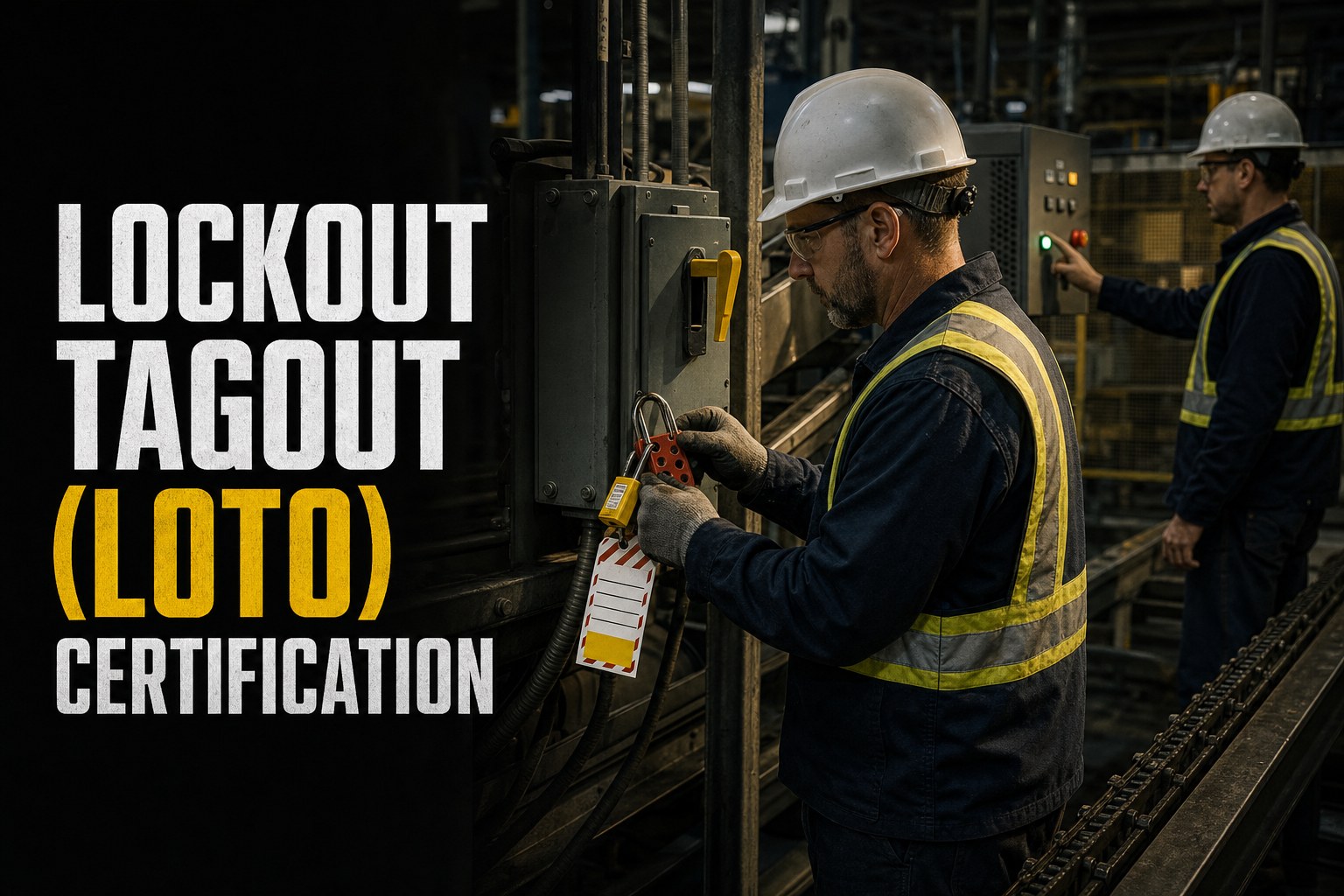
Recommended certification
Lockout Tagout (LOTO) Certification
$30 · ~1h online · certificate issued same day · valid 2 years
Also read: NFPA 70E Electrical Safety Standard Update: What Telecom Construction Workers Need to Know · ANSI/TIA Tower Standards: Preparing Your Company for Compliance
Lockout/Tagout (General Industry)
Lockout Tagout (LOTO) Certification Online covers the full general-industry program: identifying energy sources, applying locks and tags, releasing stored energy, verifying zero energy, and the one-worker-one-lock rule 1910.147 requires. It runs about 1 hour online, self-paced, with a certificate of completion the same day, valid for two years — built for anyone servicing or maintaining machines and equipment outside a construction site, including manufacturing, industrial maintenance, and facilities work. LOTO certification is the right course when the work in question is general-industry servicing and maintenance, not construction.
Control of Hazardous Energy for Construction
Control of Hazardous Energy Training for Construction is built specifically for the construction side of this gap — identifying energy sources on a job site, isolating them, and verifying it's safe before work begins, framed around the standard-specific requirements that actually apply on a construction site rather than the general-industry 1910.147 model. It runs about 30 minutes online, self-paced, with a certificate of completion the same day, valid for two years.
Recommended training: Control of Hazardous Energy Training for Construction — $35, about 30 minutes online, certificate of completion valid 2 years.
Which One Does Your Crew Actually Need?
If the work is construction — a job site, a tower, a build — Control of Hazardous Energy for Construction is the applicable training, since 1910.147 doesn't cover that work by its own terms. If the work is general-industry servicing or maintenance of machines and equipment outside a construction site, LOTO Certification is the one built for that standard. Crews that do both kinds of work — a telecom contractor with a shop and a field crew, for example — often need both courses rather than assuming one covers the other.
Frequently Asked Questions
Q: Does OSHA's LOTO standard (1910.147) apply to construction sites?
No. 1910.147(a)(1)(ii)(A) explicitly excludes "Construction and agriculture employment" from the standard's scope. Construction sites control hazardous energy through other standard-specific requirements instead.
Q: Is there one consolidated OSHA standard for hazardous energy control in construction, the way 1910.147 covers general industry?
No. Construction hazardous-energy requirements are spread across different parts of 29 CFR 1926 depending on the type of work — electrical under Subpart K, concrete and masonry under Subpart Q, power transmission under Subpart V, among others.
Q: Can I take the general LOTO course to satisfy a construction hazardous-energy requirement?
It isn't the right match. The general LOTO course is built around 1910.147's model, which by its own text doesn't apply to construction. Control of Hazardous Energy Training for Construction is framed around what actually applies on a construction site.
Q: What's the core principle both courses share?
Identifying every energy source before work begins, isolating it, and verifying it's actually safe before anyone works on or near it — the underlying safety logic is the same even though the governing standards and the specific procedures differ.
Q: How long do these courses take?
Lockout Tagout (LOTO) Certification runs about 1 hour. Control of Hazardous Energy for Construction runs about 30 minutes. Both issue a certificate of completion the same day, valid for two years.
Q: My company does both general-industry maintenance and construction work — do I need both courses?
Likely yes, since the two situations are governed by different standards. A contractor with a shop (general-industry servicing) and a field crew (construction) typically needs both trainings to cover each type of work correctly.