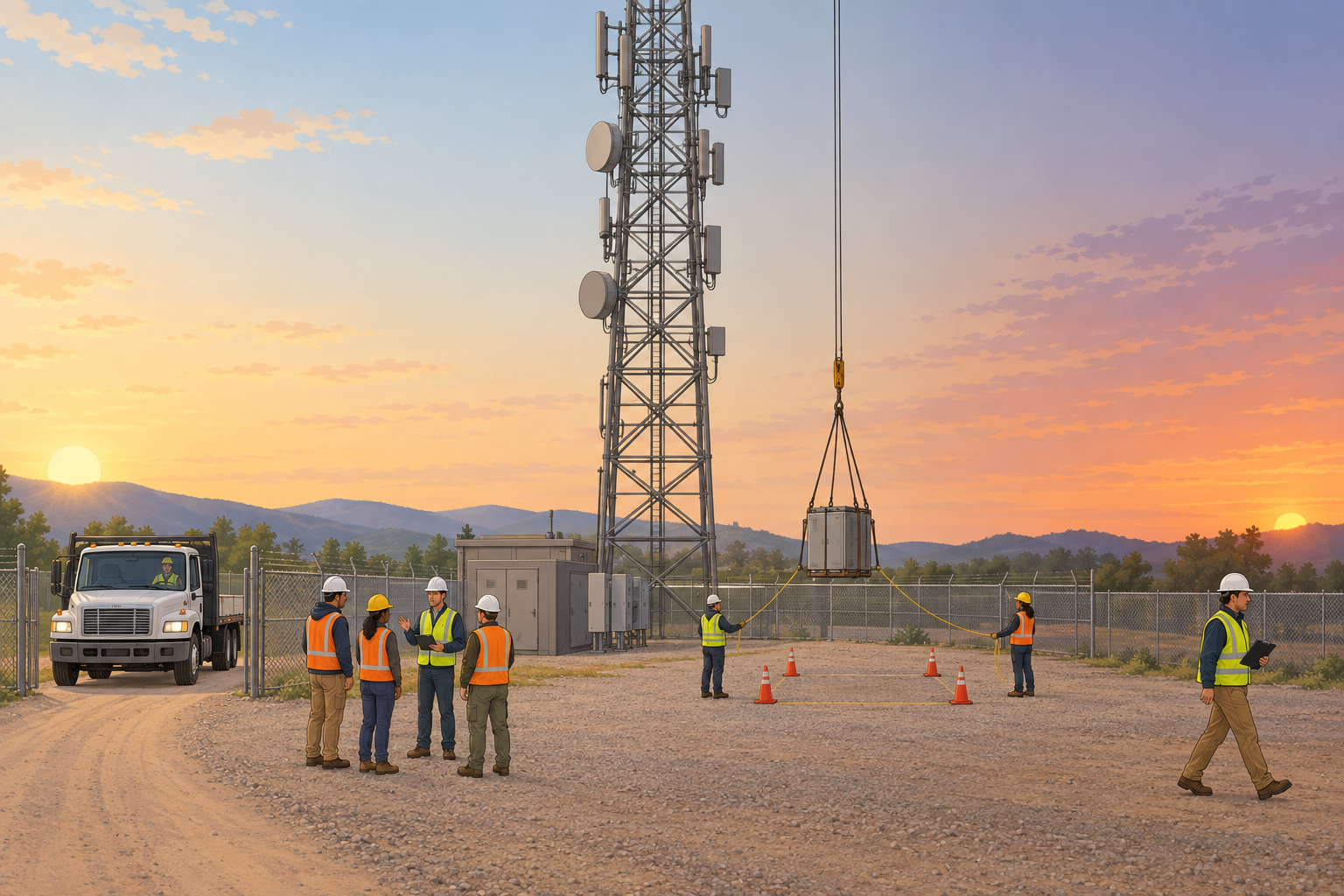
A tower technician installs, maintains, and troubleshoots the antennas, radios, and cabling mounted on cell towers, rooftops, and monopoles — spending part of the day at height on 100% fall protection and part of it on the ground rigging, staging, and running cable. No two days look identical, but every job on a real crew runs through the same sequence. Here's what that sequence actually looks like, start to finish.
Before anyone touches a tower: the morning brief
The crew shows up, gear and the truck staged at the compound, and nobody climbs anything until the JSA (job safety analysis) and tailgate briefing happen — the work order, the hazards specific to that site, and the controls for each one, reviewed and signed by everyone on the crew. Harnesses, lanyards, rope, and rigging hardware get inspected before use, every time, no exceptions. A damaged carabiner or a frayed lanyard gets pulled from service on the spot, not "used carefully."
Up top: the climber's day
Climbers stay 100% tied off the entire way up and the entire time at height — anchored to the structure's leg or a rated anchor point on a safety climb system, never to an antenna, a coax run, or a handrail. Once at the work location, the job is usually one of: installing or torquing antennas and radio units (RRUs) to spec — torqued to a number, never "by feel" — running and weatherproofing cable, or alignment work, getting an antenna's plumb, azimuth, and downtilt exactly where the RF design calls for. Every one of those follows a written method of procedure; nobody up there is improvising the sequence.
On the ground: the other half of the crew
The ground hand's day is staging and prepping gear, rigging the load that's about to go up the tower, working the tag line so the load doesn't spin or snag on the way up, holding the drop zone clear, and relaying radio traffic between the ground and the climbers. This is also the job almost everyone starts in — no climb authorization required — and it's how you learn the whole operation by watching it run instead of guessing at it. Our basic rigging course ($95, 4.5 hours) covers sling angles, hardware inspection, and how a rigging plan gets built for a communication structure specifically.
At the base: cabinets, power, and fiber
A third piece of almost every crew is base work — cabinet and power connections, grounding and bonding, fiber termination and labeling. Electrical work at the base follows lockout/tagout and is done only by a qualified electrician; everyone else on site needs to know what that work zone means and stay clear of it.
The hazards that actually define the job
Four things drive most of what a crew does all day, procedurally: falls (the reason for 100% tie-off and gear inspection before every use), RF exposure (the reason climbers check zone signage and sometimes wait on a carrier to power down before working near live antennas), rigging failure (the reason loads get a tag line and a drop zone, not just a crane hook and hope), and weather — heat, cold, and wind calls that can shut a climb down regardless of schedule. RF awareness training and PPE for telecommunications exist specifically because of the first two.
What's different between structure types
Recommended certification
TTT-1 Exam Prep: Telecommunications Tower Technician 1
$120 · ~9h online · certificate issued same day · valid 2 years
Also read: AI-Powered Drone Tower Inspections: Threat or Opportunity for Certified Climbers · Safety Training Budgets Cut 34% as Telecom Contractors Face Worst Margin Compression in a Decade
A monopole climb and a self-support lattice climb aren't the same day. A monopole is a single steel tube with internal or external step bolts or a climbing ladder — fewer places to tie off, so the safety climb system matters more. A lattice tower has leg members and cross-bracing a climber can anchor to almost anywhere along the structure, which changes how a rigging plan gets built. Guyed towers add the guy wires themselves as something the crew has to work around during rigging. Rooftop and water-tank work trade climbing height for working around building equipment, parapets, or a tank's own access hatch and catwalk — different hazards, same 100% tie-off rule. A new hand's first few jobs usually rotate through more than one type specifically so the differences stop being theoretical.
Closing out
Tools and scrap get accounted for and lowered before anyone comes down — nothing gets left at height. The day ends with photos, as-builts or redlines documenting what was actually done, and a walk of the site with the foreman before the crew leaves. On a multi-day job, tomorrow starts with the same tailgate briefing again.
A typical week, not just a day
Most crews run four to five days on a job, sometimes longer on a road assignment away from home. Weather owns the schedule more than anything else — wind limits, lightning within a set radius, and extreme heat or cold can all shut a climb down for the day regardless of what was planned, and the crew shifts to ground or base work instead of standing around. Hours run long when a site is on a carrier deadline and short when weather or a late material delivery gets in the way; "a typical day" is really a typical sequence that gets compressed or stretched depending on what the site throws at you that morning.
See it without climbing anything
Our free Entry-Level Tower Technician course walks through this exact sequence with an interactive 3D tower you rotate yourself, plus the six structure types (monopole, lattice, guyed, monopine, rooftop, water tank) and who works where on each. No card, about 2 hours, certificate of completion at the end. Or get a feel for one specific task yourself in Sector Swap — replacing an RRU and a panel antenna on a sector, ground to close-out, free and no signup. More free field tools are at /tools.
Quick answers
Is a tower technician the same as a tower climber? Mostly — "tower climber" is the common term for anyone doing the up-top work; "tower technician" is more often the job-posting title, and covers ground and base roles on the same crew too.
Do tower technicians work alone? No. Fall protection and rigging work on a tower are crew jobs by structure and by practice — someone's always on the ground running the tag line, holding the drop zone, and watching the climber's back.
What's the hardest part of the job day to day? Most techs say it's not the height — it's the heat, the cold, and the hours. Weather calls and long drives between sites shape the job more than nerves at height do.
Can I start without being able to climb yet? Yes — almost everyone starts as a ground hand, which needs no climb authorization, and earns climbing time on the job once an employer trains and evaluates them.