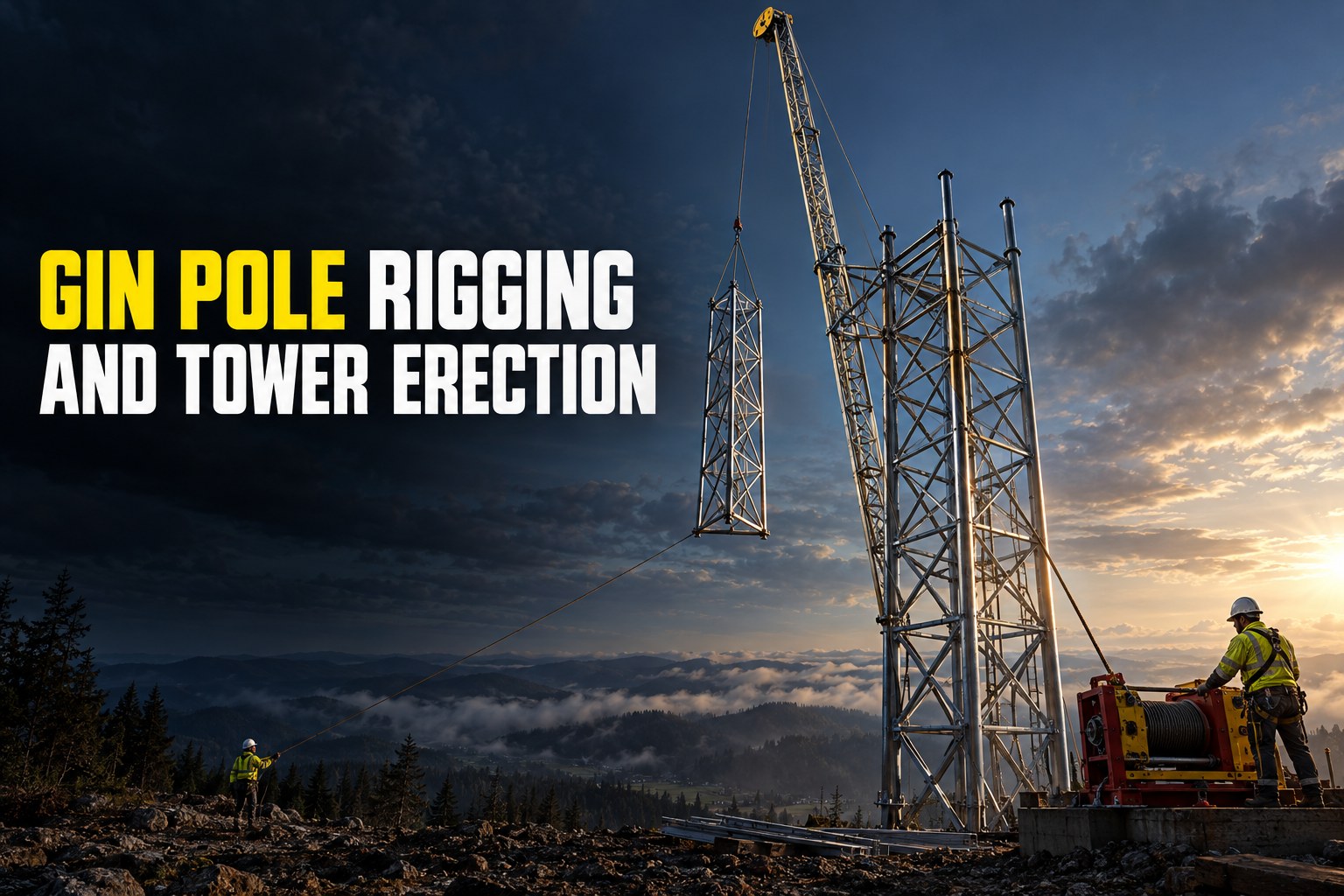
A gin pole is a lifting device mounted on top of a communication tower and used to hoist tower sections, antennas and other loads up the structure itself — instead of relying on a mobile crane working from the ground. It attaches to the top of the tower (or the top of the section already erected), extends above it, and uses a load line run through a block to lift the next piece into place. Once that piece is bolted up, the pole gets "jumped" up to the new top and the process repeats.
This is the core method behind most tower erection and significant tower rebuilds, especially on guyed structures or sites where a crane can't be positioned or isn't cost-effective for the height involved. It's also one of the highest-consequence rigging operations in telecom construction, which is exactly why ANSI/ASSP A10.48-2023 classifies gin pole work as a Class IV lift regardless of the actual load weight.
How a Gin Pole Actually Works
Lattice vs. tubular
Gin poles come in two basic configurations — lattice (built like a small tower section) and tubular (a single round or square tube) — and the choice affects capacity, reach and how the pole gets attached and guyed.
Reading the load chart
Every gin pole has a manufacturer's load chart that sets capacity based on configuration, reach and guying — it's not a single number. A rooster head (the sheave arrangement at the top) versus a top block changes both the working load limit and the D/d ratio the load line is running over.
Attachment to the tower
The pole attaches to the tower legs using a bridle, basket or heel plate arrangement, then gets guyed, collared and plumbed before any load goes on the line. The load line itself reeves from a heel block near the base up through the rooster head at the top.
Recommended certification
Gin Pole Rigging & Tower Erection
$149 · ~6h online · certificate issued same day · valid 2 years
Also read: Detroit Cell Site Battle: Why Clear Easements Matter for Tower Crews · Westlake, TX Cell Tower Battle: Federal Order vs. Local Appeal
Erecting the Tower, Section by Section
Once the pole is set and the load line is reeved, erection follows the engineer's erection plan — sections go up in a specific order, with temporary guys keeping each new section aligned until the permanent guying is in place. Bolt-up at each connection follows a specified torque and pattern, verified before the next section goes up and loads that connection further. The ground crew and the pole operator function as one coordinated system throughout — a miscommunication at the base is just as dangerous as one at the top.
Why It's Always a Class IV Lift
Under ANSI/ASSP A10.48-2023, gin pole work is classified as Class IV regardless of the actual weight being lifted, because the pole itself is part of the structure being modified, the operation happens entirely at height, and a failure doesn't just drop a load — it can compromise the tower section the pole is attached to. That classification brings specific requirements: a qualified engineer has to be involved in planning, a competent rigger oversees the lift, and operational wind limits are stricter than they would be for a comparable ground-based lift.
What the Course Covers
BuildRight's Gin Pole Rigging & Tower Erection course ($149, about 6 hours) is a deep-dive into exactly this equipment and process: gin pole types and reading a manufacturer's load chart, setting the pole on the tower (bridle, basket, heel plate, guying and plumbing), jumping the pole step by step, erecting the tower by sections under the engineer's plan, and planning the work as the Class IV lift it is under A10.48-2023 — including who signs off as qualified engineer, competent rigger and qualified person. It closes with dismantling procedures, heavy lift considerations, and a review of incident patterns OSHA and NATE see repeated in gin pole work.
This course is currently in final review before publication and isn't open for enrollment yet. It builds directly on the fundamentals in Basic Rigging Principles on Communication Structures — most crews should have that rigging foundation in place before moving into gin pole–specific training.
Frequently Asked Questions
Is a gin pole the same thing as a crane?
No. A crane is a separate piece of mobile equipment that lifts from the ground. A gin pole is mounted on the tower itself and lifts loads up the structure from above — it's used specifically where a crane can't reach the height involved or isn't practical for the site.
Why is gin pole work always treated as a Class IV lift?
Because the lifting device is attached to the structure being built or modified, and the entire operation happens at height. ANSI/ASSP A10.48-2023 classifies it as Class IV regardless of the load's actual weight, which brings stricter planning, engineering and wind-limit requirements.
What does "jumping the pole" mean?
It's the process of moving the gin pole from its current position up to the top of the section just erected, so it can lift the next section. It's considered the highest-risk step in the entire erection sequence because the pole is temporarily repositioned at height.
Who has to sign off on a gin pole lift plan?
Under A10.48-2023, the plan typically involves a qualified engineer, with a competent rigger overseeing execution and a qualified person involved in specific tasks — the exact roles and sign-offs depend on the lift's classification and complexity.
Does a mobile crane operator need gin pole training?
Generally no — gin pole rigging is a distinct skill set from mobile crane operation, used specifically for tower erection work where the lifting device is part of the structure rather than a separate crane.