Medium Voltage
Safety Training Online · 1–35 kV
Qualified-worker training for the 1–35 kV world: step and touch potential, arc flash where the incident energy is in another class, approach distances and how their numbers are set, switching and test-before-touch, temporary protective grounding, rubber gloves and live-line tools. 3.5 hours, self-paced, certificate of completion the same day.
Built to OSHA standards · Unlimited free retakes
3.5 hours
self-paced, any device
Same day
certificate of completion
2 years
verifies online by code
Free retakes
on the final test, unlimited
What counts as medium voltage, and why it needs its own course
Medium voltage is the band from roughly 1,000 volts up to 35 kV — the distribution side of the system rather than the utilization side. It is what feeds a pad-mount transformer, runs through a substation, travels a feeder, and arrives at the switchgear that steps it down to something a building can use. There is no single legal definition: OSHA 1910.269, IEEE and your employer’s own procedures each draw the line in slightly different places, and the one that governs you is the last of the three.
Above a kilovolt the physics stops being a matter of degree. Current no longer waits for contact — it arcs across air, it spreads through the ground around a fault as step and touch potential, and it appears on a line you switched out yourself through capacitive coupling and induction from the circuit running beside it. Incident energy at a medium voltage fault is in a different class from a 480 V panel, and so are the clearances and the PPE that answer it.
Where this sits next to QEW and NFPA 70E. Those two are built around work below 1,000 volts, which is most electrical work and most of what NFPA 70E was written for. This course starts where they stop: OSHA 1910.269 and 1926 Subpart V, minimum approach distance, switching orders, temporary protective grounding, and the vault and manhole work that comes with distribution gear. The overlap in PPE and first aid is deliberate — people buy one course, not two.
Read this before you buy from anyone
The numbers are not ours to hand you. Neither is the qualification.
Minimum approach distances, rubber glove classes and approach boundaries live in the standards and in your employer’s written procedures, and they move with system voltage, with the equipment, and with whether the line is grounded. This course teaches you where each number comes from, how to read the table that actually governs your work, and why working from someone else’s table is how people are hurt — it deliberately does not print one for you to memorise. The other half is designation: OSHA and NFPA 70E both leave “qualified person” in the employer’s hands, judged on the specific equipment and task, and no certificate settles that for them.
The training
Where every number comes from and how to work from the table that governs you — documented with a certificate that verifies online.
The numbers and the designation
Your employer’s procedures and the standard’s own tables, plus the call that you are qualified on that specific gear.
What the training covers
7 modules · 20 lessons, final assessment included. Full lesson list →
- 01
What medium voltage is and where it lives
The 1–35 kV band, substations, switchgear and distribution, and who may lawfully work on any of it.
- 02
Step and touch potential
How fault current spreads through the ground around you, why the danger is the difference between your two feet, and what to do about it.
- 03
Arc flash above a kilovolt
Why incident energy jumps, plus stored and induced energy: capacitance, backfeed, and coupling from the circuit next door.
- 04
Boundaries and minimum approach distance
OSHA 1910.269 and 1926 Subpart V, NFPA 70E boundaries at medium voltage, and how an MAD figure is actually derived.
- 05
Switching, test before touch, grounding
Switching orders and operating procedures, proving dead with an instrument you proved first, and temporary protective grounding.
- 06
PPE, live-line tools and enclosed spaces
Arc-rated clothing at higher energy, rubber glove classes and testing, insulated aerial devices, vaults and manholes, and rescue after contact.
Who needs medium voltage training
The people who cross from utilization voltage into distribution voltage, usually before the paperwork catches up. A worker qualified below 1,000 volts is not automatically qualified at 15 kV, and that gap is where the incidents sit.
Utility and substation technicians
Feeders, reclosers, switchgear and the switching orders that govern all of it.
Industrial maintenance and plant electricians
Customer-owned medium voltage: pad-mounts, unit substations, and the feeder nobody wants to own.
Electricians moving up from 480 V
The step where habits that were safe below a kilovolt stop being safe above it.
Telecom and data centre crews
Primary metering, medium voltage service into a shelter, and generator and UPS switchgear.
How it works
- 1
Enrol
Card checkout, no account needed up front — you set your password the moment you pay.
- 2
Study at your pace
On any device. Progress saves, so you can stop mid-lesson and pick it up on the truck.
- 3
Pass the test
Multiple-choice final assessment. Unlimited retakes, free — nobody pays twice for a second attempt.
- 4
Download the certificate
Issued the same day with a unique code that verifies online for 2 years.
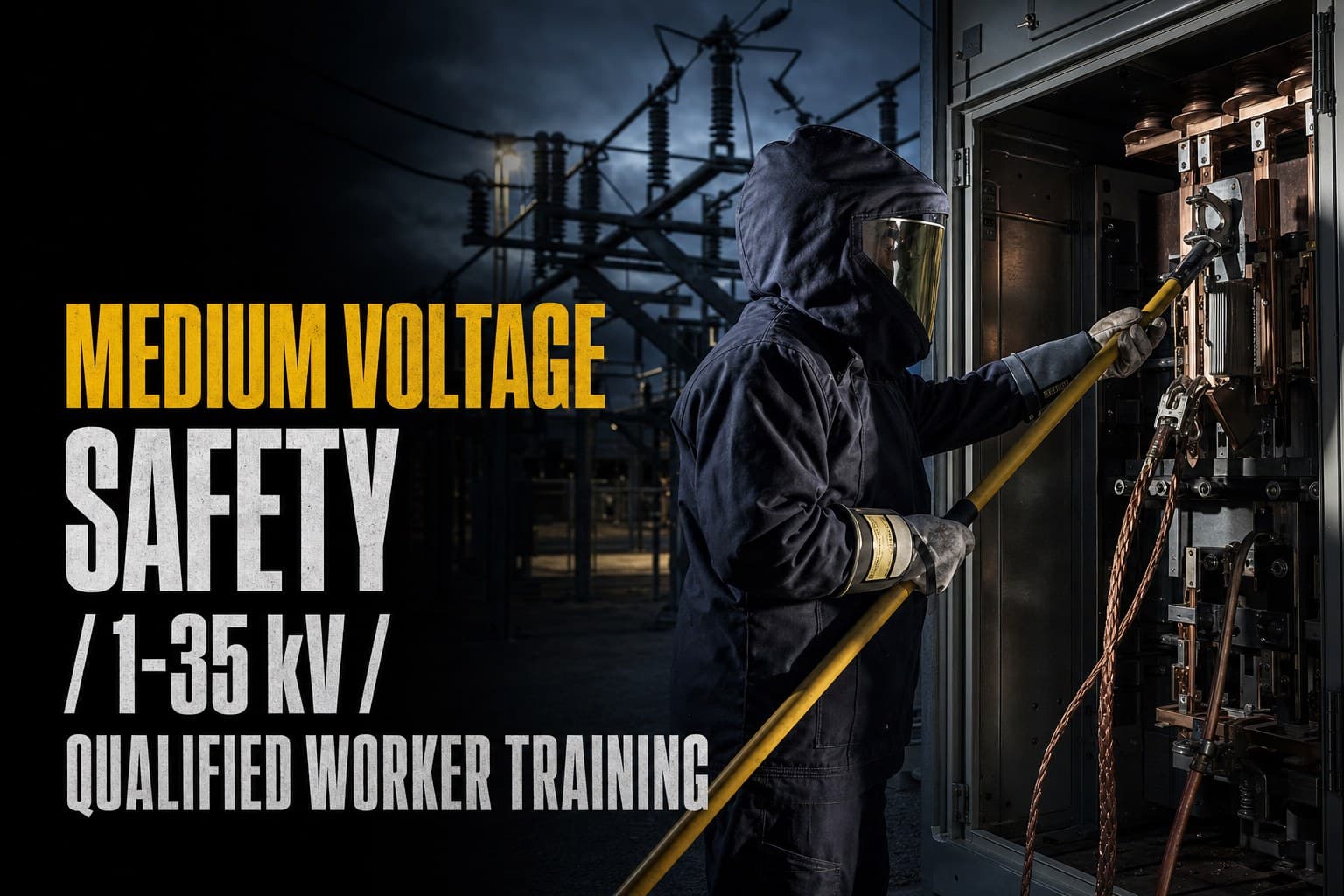
Medium Voltage Safety (1–35 kV) — Qualified Worker Training
3.5 hours, self-paced, on any device. Unlimited free retakes on the final test. Certificate of completion issued the same day and verifiable online for 2 years.
Frequently asked questions
What is medium voltage?
Broadly, the band from about 1,000 volts to 35 kV — distribution voltage rather than the utilization voltage inside a building. The exact boundaries differ between OSHA 1910.269, IEEE and individual employers, which is itself worth knowing: the definition that matters on your job is the one written into your employer’s procedures, not the one in a textbook.
Does this course make me qualified to work on medium voltage equipment?
It delivers the training half and documents it. The designation is your employer’s: OSHA and NFPA 70E both require that a qualified person has been trained *and* has demonstrated skills on the specific equipment and task. Someone can be qualified on a pad-mount and unqualified on the substation behind it. Our certificate gives your employer the training record they need to make that call.
How is this different from the QEW course?
The Qualified Electrical Worker course is built around work below 1,000 volts and around the designation itself — what makes someone qualified and who decides. This one starts above a kilovolt, where step and touch potential, minimum approach distance, switching orders and temporary protective grounding come into play, and where the governing regulations shift to OSHA 1910.269 and 1926 Subpart V. If you work both sides of a transformer, you want both.
Why does the course not give me the minimum approach distances?
Because a number reproduced from memory into a training slide is how somebody gets hurt. Minimum approach distances depend on system voltage, on transient overvoltage, on altitude and on whether the line is grounded, and they exist in the standard’s tables and in your employer’s procedures. The course teaches you where the numbers come from, how to read the right table, and why you never work from a table you found somewhere else.
How long does the course take?
About three and a half hours, self-paced, on any device. Progress saves as you go, so most people split it across two or three sittings. The final test is multiple choice with unlimited free retakes.
How long is the certificate valid?
Two years, verifiable online by its unique code for that whole period, and we email you before it expires. NFPA 70E asks for retraining at intervals not exceeding three years; two years is the interval most employers and site owners actually run, and it leaves room for the triggers that shorten it.
Is this course OSHA-approved?
No provider’s course is. Outside the OSHA Outreach Training Program — the OSHA 10/30 DOL-card system delivered by OSHA-authorized trainers — OSHA does not approve, accept or certify training. Our courses are built to OSHA standards, and what you receive is a certificate of completion that verifies online by its own code. Whether it satisfies a given site is the employer’s or site owner’s decision.
Can I train a whole crew at once?
Yes. Buy seats once from the team dashboard, assign the course to each worker, and watch completion in real time. You get a certificate roster with QR codes to show a site checker without chasing anyone for paperwork.
Related electrical safety training
$95
3.5 hours · certificate today