RF exposure limits for people working near antennas come from the FCC, not OSHA. The FCC's maximum permissible exposure (MPE) limits — 47 CFR § 1.1310 — define the occupational/controlled and general-population exposure zones that RF safety training is built around. OSHA has no RF-specific exposure standard of its own; it addresses RF hazards through the General Duty Clause when exposure is a recognized, preventable hazard, pointing back to the FCC's limits rather than a dedicated OSHA number.
That split confuses a lot of crews, because the training itself gets called "OSHA RF safety" on job sites out of habit. It isn't an OSHA standard by name — it's a federal requirement that happens to come from a different agency, enforced through a different mechanism.
Who Actually Sets the Exposure Limits
The FCC sets RF exposure limits under 47 CFR § 1.1310, because RF emissions are a communications-spectrum issue the FCC regulates at the source — the transmitter and antenna system itself — not a workplace-conditions issue in the way OSHA typically regulates. The limits define two tiers:
- Occupational/controlled exposure — higher limits that apply to people who are trained, aware of the exposure, and can control their time near the source (tower climbers, RF technicians).
- General population/uncontrolled exposure — lower limits for people who haven't been made aware of exposure and can't control their own time near it (the public, untrained visitors to a site).
The practical effect: a trained worker with monitoring and awareness is held to a different, higher exposure allowance than an untrained bystander — which is exactly why the training itself is what unlocks the "occupational" tier rather than defaulting everyone to the stricter public limit.
Where OSHA Fits In
OSHA doesn't duplicate the FCC's limits with its own RF standard. Instead, OSHA can cite an employer under the General Duty Clause (Section 5(a)(1) of the OSH Act) if RF exposure on a site is a recognized hazard and the employer didn't use feasible controls — signage, barriers, power-down coordination, monitors — to manage it. In practice, OSHA inspectors and citations lean on the FCC's own exposure limits as the technical benchmark for what "hazardous" RF exposure means, rather than writing a separate number.
So the honest answer to "is this OSHA or FCC" is both, in different roles: the FCC sets the actual exposure limits, and OSHA can still enforce against an employer who ignores them.
Who Sets RF Rules — FCC vs. OSHA
| | FCC | OSHA |
|---|---|---|
| Sets the exposure limits | Yes — 47 CFR § 1.1310 | No RF-specific standard |
| Enforcement mechanism | Licensing and compliance for transmitter operators/site owners | General Duty Clause (Section 5(a)(1)) for employers |
| What it's protecting | Public and worker exposure to RF energy from transmitters | Worker safety generally, including recognized RF hazards |
| Who it directly regulates | Carriers, licensees, transmitter operators | Employers of exposed workers |
Why Carriers Require RF Training Even Without One Named Mandate
Site owners and wireless carriers require RF awareness training before granting tower or rooftop access — not because one single federal law says "every climber needs RF training," but because the FCC's exposure limits exist, the risk is real, and denying access to untrained workers is the simplest way a carrier protects itself and the public from an exceeded-limit incident. It's also, more simply, the responsible thing to do before anyone works near a live antenna.
What RF Awareness Training Actually Covers
Recommended certification
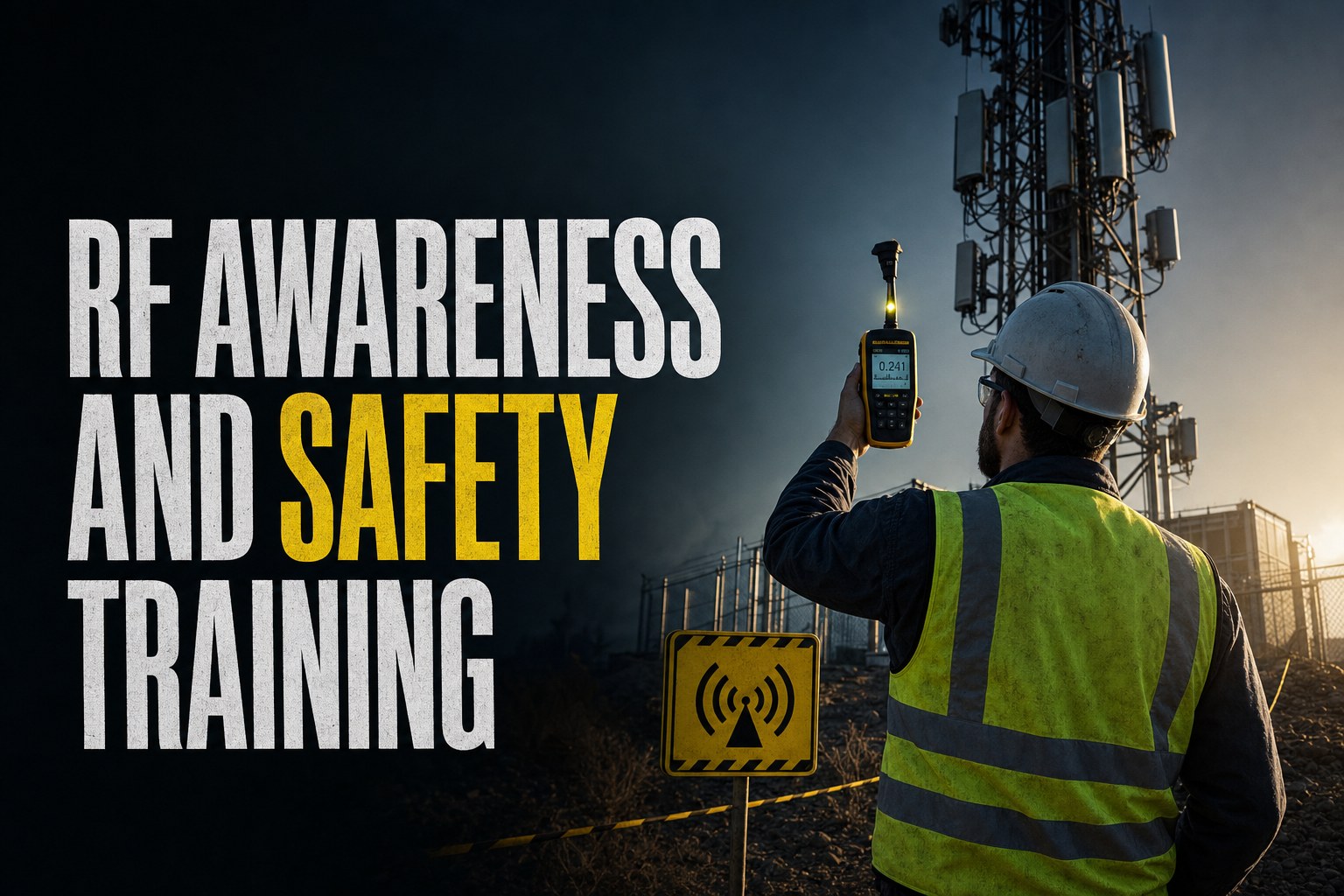
RF Awareness & Safety Training
$49 · ~1h online · certificate issued same day · valid 2 years
Also read: ANSI/TIA Tower Standards: Preparing Your Company for Compliance · When the Market Falls, Bodies Follow: The Deadly Link Between Economic Downturns and Tower Climbing Deaths
RF Awareness & Safety Training is built around the FCC's exposure framework and covers what a climber or rigger actually needs on site:
- RF exposure limits and power density, in plain terms
- Reading RF warning signage and color-coded barriers
- Using a personal RF monitor correctly
- Transmitter lockout and coordination procedures before working near an antenna
It runs about 1 hour online, self-paced, with a certificate of completion the same day, valid for two years, and it's accepted by telecom employers and site owners nationwide as proof of RF awareness before granting access.
It's Not Just a Paperwork Requirement
A personal RF monitor and a signed-off training certificate don't replace the actual coordination step — confirming with the carrier that a transmitter is powered down or detuned before work starts near it. RF awareness training covers both halves: understanding the FCC's exposure limits well enough to read a site's signage and zones correctly, and knowing the lockout/coordination procedure that has to happen regardless of what a monitor reads.
Frequently Asked Questions
Q: Is RF safety training an OSHA requirement?
Not by name — OSHA has no RF-specific standard. It can still cite an employer under the General Duty Clause for ignoring a recognized RF hazard, using the FCC's exposure limits as the technical reference for what's hazardous.
Q: What are the actual RF exposure limits based on?
The FCC's maximum permissible exposure (MPE) limits under 47 CFR § 1.1310, which set different thresholds for trained occupational workers versus the untrained general public.
Q: Why do I need training if the FCC sets the rules, not OSHA?
Because the FCC's higher "occupational" exposure tier only applies to workers who are trained and aware of the exposure — untrained workers are held to the stricter general-population limit. Training is also what carriers and site owners require before granting access, regardless of which agency's number is technically in play.
Q: Does a personal RF monitor mean I don't need to worry about lockout procedures?
No. A monitor warns you when you're in a hazardous field — it doesn't replace confirming with the carrier that a transmitter is powered down or detuned before work starts. The course covers both.
Q: How long does RF awareness training take, and how long is the certificate valid?
About 1 hour online, self-paced, with a certificate of completion the same day, valid for two years and verifiable online by its own code.
Q: Who needs RF awareness training?
Tower climbers, riggers, and any crew working on or near active RF transmitters — rooftop, DAS, and small-cell work included.