
OSHA has proposed $380,664 in penalties against Always Underground LLC, a Frankfort, Illinois utility construction company, after inspectors saw employees working in an unprotected trench deeper than eight feet. Three of the four citations were classified as repeat violations.
The news release is dated October 21, 2026. For anyone who digs, whether for fiber conduit, power, or tower foundations and ground systems, the case is a clear look at what OSHA inspectors are checking in a trench and how quickly the numbers add up when the same problems come back.
What OSHA cited
According to the Department of Labor, the inspection found employees working in an unprotected trench deeper than eight feet. OSHA cited the employer for three repeat violations:
- Failing to provide workers with a safe means of egress.
- Failing to install a trench protective system that would protect against cave-ins.
- Failing to keep excavated or other materials and equipment at least 2 feet from the edge of the trench.
OSHA also cited one serious violation: failing to provide workers with protective hardhats against falling objects.
In total, OSHA proposed $380,664 in penalties. The employer has 15 business days from receipt of the citations and penalties to comply, request an informal conference with the area director, or contest the findings before the independent Occupational Safety and Health Review Commission. The release also carries a standard notice that penalty amounts and classifications may change as a case moves forward.
Why the repeat classification matters
In general, OSHA treats a violation as repeat when an employer has previously been cited for the same or a substantially similar condition. That classification carries much higher penalty potential than a first-time serious citation, which is why a single trench can produce a six-figure proposal.
The release does not describe the earlier citations, so there is nothing more to say about the company's history. The practical point stands on its own: a trench that was inspected once and cited once is not finished business. If the same conditions show up on the next job, the penalty math changes.
The three repeat items are also not exotic. Egress, cave-in protection, and spoil placement are the basics of trench work. They are the first things a competent person should verify before anyone steps below grade.
Why this inspection happened at all
OSHA said the investigation began as part of its National Emphasis Program on Trenching, after inspectors witnessed employees in the unprotected trench. That detail is worth underlining. This was not a response to an injury or a complaint, as far as the release says. Inspectors saw a hazard and opened an inspection.
Emphasis programs mean crews should assume a trench in plain view of a road, a neighborhood, or a passing compliance officer can trigger scrutiny. Utility and telecom contractors who open ground along public rights-of-way work in exactly that kind of visible setting.
A trench is only as safe as its worst hour. If protection goes in after lunch, or the ladder shows up after the first crew member is already down, an inspector arriving at the wrong moment sees an unprotected trench.
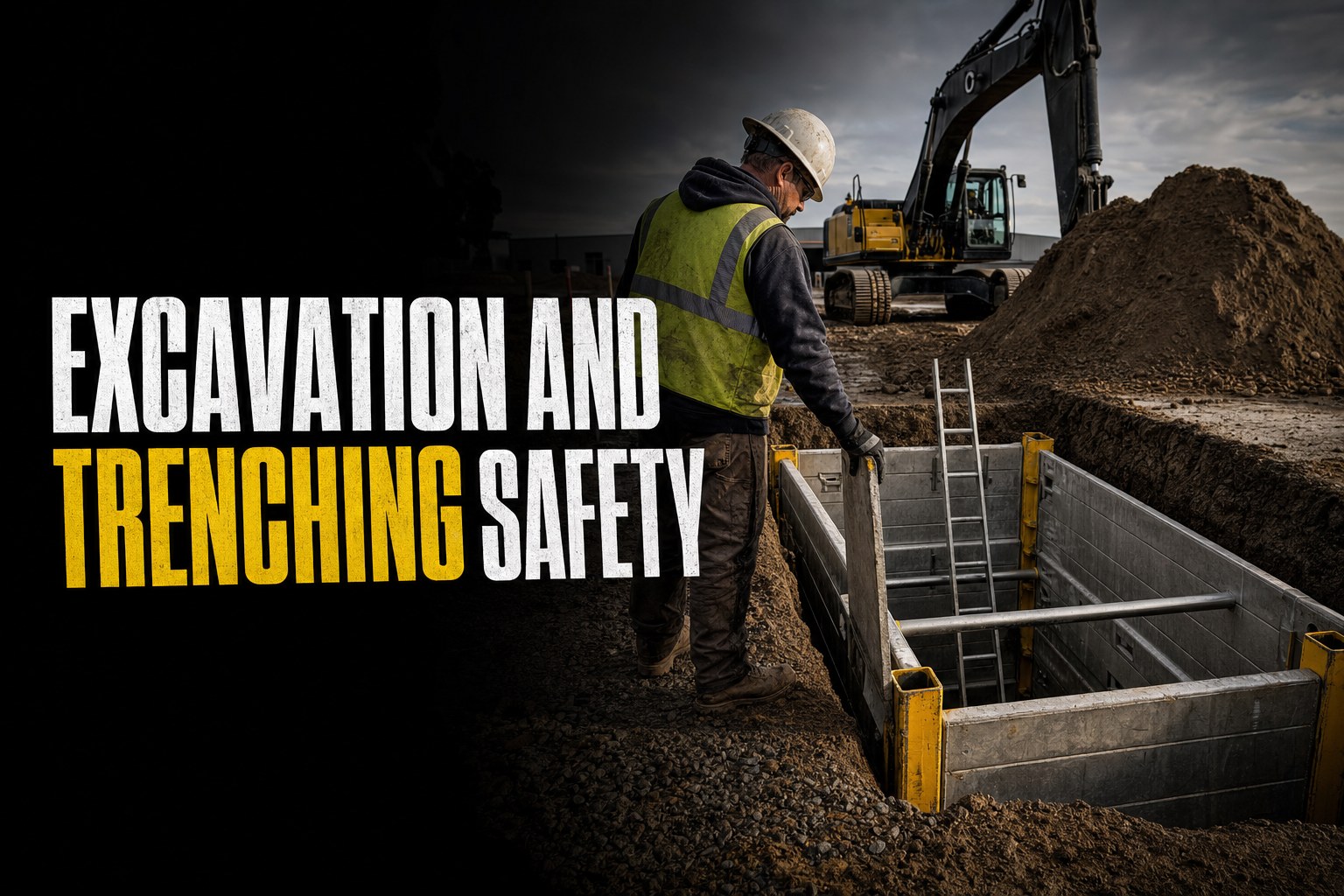
Recommended certification
Excavation and Trenching Safety
$35 · ~3.5h online · certificate issued same day · valid 2 years
Also read: Houston Contractor Fined $343K After Excavation Collapse · Breland Homes Faces $115,855 OSHA Penalties After Fatal Trench
What this means for crew leads
The cited items map to checks that take minutes. Under the general excavation rules in 29 CFR 1926 Subpart P, a trench that reaches five feet generally needs a protective system unless it is cut in stable rock, and trenches four feet or deeper need a way out within a short lateral distance of workers. Spoil and equipment belong back from the edge. Confirm the exact requirements for your conditions with your competent person and the standard itself.
A short pre-entry routine keeps these from slipping:
The hardhat citation is a good reminder that the serious violation in this case was not about the trench wall at all. Overhead exposure is real when material and machines work at the edge, which loops back to the spoil-distance citation.
Egress, cave-in protection, and spoil placement are the basics of trench work, and they are the first things to verify before anyone steps below grade.
What this means for safety managers
Repeat findings usually come from process gaps, not a single bad day. A few questions to ask your own operation:
- Do your field audits catch trench conditions after the first crew leaves the site, or only on scheduled visits?
- When a crew gets a verbal warning or a near miss on a trench, is it written down and shared with other crews?
- Do subcontractors and short-term crews get the same competent-person expectations as your regular employees?
- Can a crew lead stop a job when protection or egress is missing, without fear of schedule pushback?
Documentation helps here. Daily trench inspection records and corrective action logs show a pattern of attention if OSHA ever asks, and more importantly they make repeat problems visible to you first.
What happens next
The employer can comply, ask for an informal conference, or contest the findings. Because penalty amounts and classifications can change, the proposed figure is a starting point rather than a final outcome. OSHA suggests checking its establishment search page periodically for updates on the inspection and penalty status.
OSHA also points employers to its trenching and excavation resources and to free compliance assistance. Both are worth using before an inspector shows up, not after.

