No. An electrician's license is a state-issued credential that proves general electrical-trade competency. "Qualified person" status under 29 CFR 1910.332 is a narrower, employer-made determination that someone has the specific training to work safely on or near the energized equipment in front of them — distinguishing exposed live parts, judging nominal voltage, and applying the correct clearance distances. A state license doesn't automatically make someone a "qualified person" on a given job, and being a Qualified Electrical Worker (QEW) doesn't require a state electrician's license. The two can overlap, but they're legally separate things.
What 1910.332 Actually Requires
OSHA's training standard for electrical safety, 29 CFR 1910.332, doesn't hand out a credential — it lists what someone has to be able to do before they're allowed to work on or near exposed energized parts. Specifically, a "qualified person" has to be trained to:
- Distinguish exposed live parts from other parts of the equipment
- Judge the nominal voltage of exposed live parts
- Know the minimum approach distances for the voltages involved
- Use the correct PPE and tools for the work
Nothing in the standard says a state electrician's license satisfies this automatically. A licensed electrician who hasn't had this specific training is not a "qualified person" under 1910.332, and someone without a state license who has had this training can be.
Who Actually Decides If You're "Qualified"
The employer does — not a training provider, not a test score, and not the worker themselves. 1910.332 sets the training content, but the standard leaves the actual determination of "qualified person" status with the employer, who has to confirm the worker can apply that training on the job in front of them. A course delivers the classroom knowledge; it's the employer's call whether a given worker meets the standard for a given task.
This is also why QEW training doesn't expire the way a license renewal does — an employer can require refresher training on their own schedule, and a new employer makes their own qualified-person determination regardless of what a previous employer decided.
Do Non-Electricians Need This Training Too?
Yes. 1910.332 isn't written for licensed electricians specifically — it covers anyone exposed to electrical hazards as part of their job. That includes:
- Apprentices working toward a license
- Industrial maintenance technicians who service equipment with exposed electrical parts
- Telecom and tower technicians working near power feeds, generators, or site electrical equipment
A state electrician's license isn't a prerequisite for QEW training, and plenty of people who take it are never going to hold one — they just need to work safely around energized equipment as part of a different job.
Where NFPA 70E Fits In
NFPA 70E is the practical safety framework that 1910.332 training points to. It's where the arc-flash and shock-hazard boundaries, PPE category tables, and energized-work permit rules actually live. 1910.332 says you have to be trained to recognize hazards and keep safe distances; NFPA 70E is the industry-standard method for calculating those distances and choosing the right PPE category for the voltage and equipment involved. A QEW course built on NFPA 70E teaches both pieces together rather than leaving a worker to connect OSHA's requirement to the NFPA tables on their own.
License vs. Qualified Person Status
Recommended certification
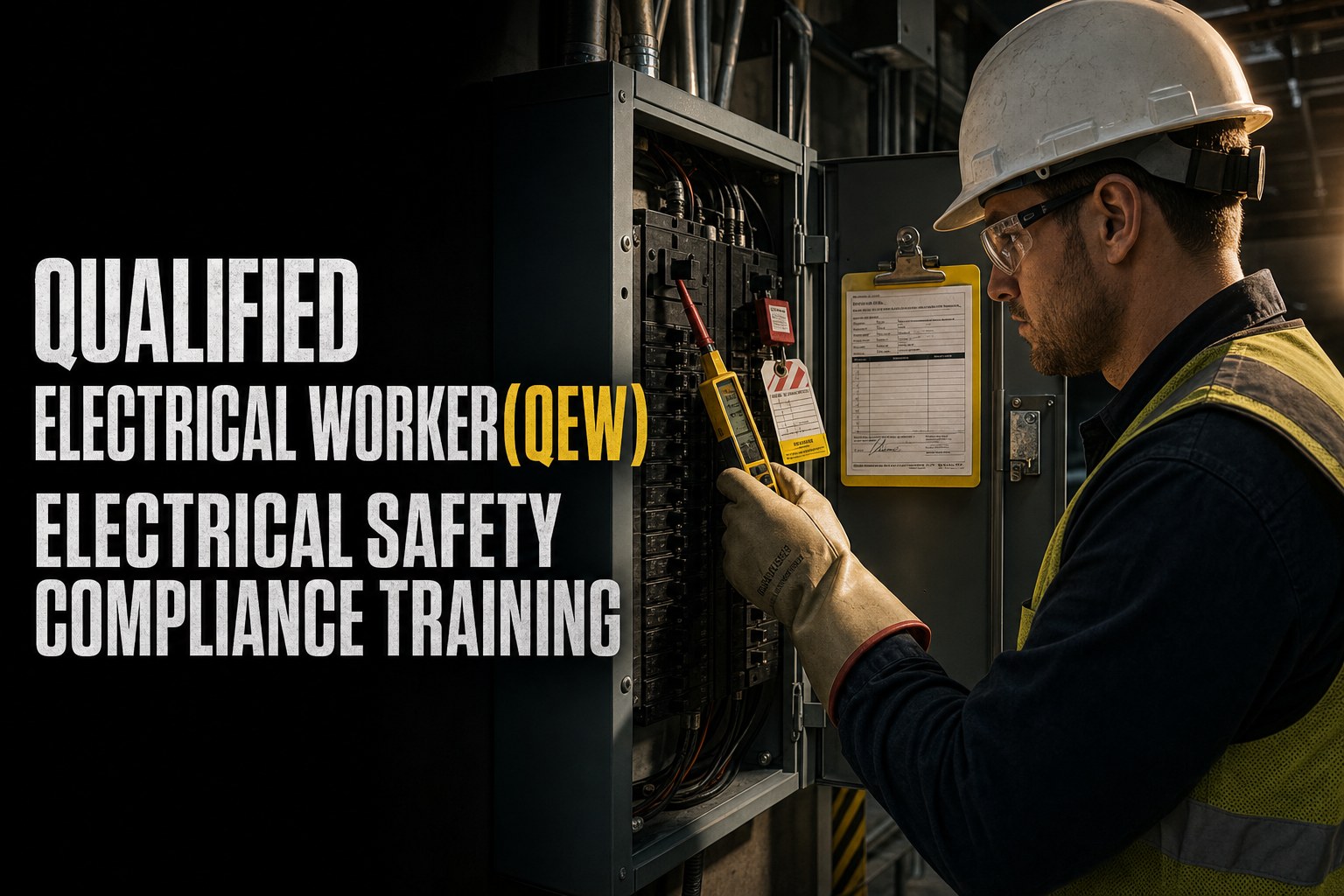
Qualified Electrical Worker (QEW) — Electrical Safety Compliance Training
$99 · ~3h online · certificate issued same day · valid 2 years
Also read: QEW Certification Online: Qualified Electrical Worker Training Guide · AI-Powered Drone Tower Inspections: Threat or Opportunity for Certified Climbers
| | Electrician's License | QEW / Qualified Person Status |
|---|---|---|
| Issued by | The state | Determined by the employer |
| Proves | General electrical-trade competency | Specific training for the energized work in front of you |
| Governing rule | State licensing law | 29 CFR 1910.332 |
| Portable between employers | Yes, within the state | No — each employer makes its own determination |
| Expires | On the state's renewal schedule | No fixed expiration; employers set refresher schedules |
What a QEW Course Covers
Qualified Electrical Worker (QEW) training is built on NFPA 70E and covers arc-flash and shock-hazard boundaries, PPE category selection, energized-work permits and justification, and the approach-boundary rules that 1910.332 training points to — about 3 hours online, self-paced, with a certificate of completion the same day, valid for two years. It's written for electricians and apprentices as well as industrial maintenance staff and telecom or tower crews who work near energized equipment without holding an electrician's license. The course delivers the classroom half of 1910.332's requirement; your employer still makes the actual "qualified person" determination based on the job in front of you.
Crews that need the full picture often pair QEW training with site-specific hands-on evaluation so the classroom knowledge and the employer's sign-off happen together rather than months apart.
Frequently Asked Questions
Q: If I have an electrician's license, do I still need QEW training?
Yes, if your employer hasn't already confirmed you meet 1910.332's "qualified person" criteria for the specific equipment and voltages you'll work with. A license proves general trade competency; it doesn't automatically satisfy OSHA's training requirement or make the employer's qualified-person determination for you.
Q: Can I become a "qualified person" without ever getting an electrician's license?
Yes. 1910.332 doesn't require a state license — it requires training in recognizing live parts, judging voltage, and keeping safe distances, plus an employer determination that you can apply that training. Many telecom technicians and industrial maintenance workers are qualified persons without holding an electrician's license.
Q: Does a QEW certificate transfer if I change employers?
The certificate of completion itself does — it's yours, verifiable online by its own code for two years. But the "qualified person" determination that goes with it is employer-specific: a new employer has to make its own determination that you can apply that training to their equipment and tasks, even if you're bringing the same certificate with you.
Q: How long does the QEW course take, and when do I get a certificate?
About 3 hours, self-paced online. You get a certificate of completion the same day you pass the final quiz.
Q: Is this course only for people who already work with electrical panels or wiring?
No. It's written for anyone who works on or near energized equipment, which on telecom and construction sites includes people whose main job isn't electrical work at all — tower technicians near site power, maintenance staff servicing powered equipment, and apprentices building toward a license.
Q: Does the course replace NFPA 70E's own arc-flash risk assessment for a specific job?
No. The course teaches the boundaries, PPE categories, and permit process NFPA 70E defines, but a site-specific arc-flash risk assessment still has to account for the actual equipment, voltage, and available fault current on that job. The course gives you the framework to understand and apply that assessment, not a substitute for doing it.