You don't need climbing experience, a telecom background, or a connection in the industry to get hired on a tower crew. What you need is a handful of entry certs most contractors check for before site access, a ground-hand attitude, and a clean-enough background check. Here's the actual order that gets people hired — not the order job boards list it in.
What "no experience" really means here
Nobody expects a new hire to show up knowing rigging, RF exposure limits, or how to read a site drawing. What every foreman does expect: you show up on time, you follow directions without arguing, you don't freeze up around heights, and you can prove — on paper — that someone already walked you through the basics of not getting hurt or getting the crew shut down. That paper is the entire first step.
Step 1: See the job before you spend a dollar
Before buying any certification, take the free Entry-Level Tower Technician course. It's about 2 hours, no card required, and walks through the six structure types you'll see on the job (monopole, lattice self-support, guyed, monopine, rooftop, water tank), who works where on a crew — up top, on the ground, at the base — and the real hazard patterns: falls, RF exposure, dropped objects, electrical, rigging, weather. You get a certificate of completion, not a hiring credential. Its job is to make sure you know what you're signing up for before you spend money on anything else.
Step 2: Get the three certs almost every site checklist wants
Most site access checklists are written as crew percentages, not individual requirements — but these three show up on nearly every one, and a hand without them can't be counted toward the crew at all:
- Fall protection — $30, 30 minutes. Harness, 100% tie-off, anchor points, inspection. You do not go up without this, full stop.
- RF awareness — $49, 1 hour. Reading exposure zones and site signage around live antennas — the card whose absence benches a crew fastest.
- First aid / CPR — $40, 1 hour online, often paired with a hands-on skills check your employer arranges separately.
That's $119 and about two and a half hours of coursework for the package most ground-hand job postings actually ask for.
Step 3: OSHA 10 — from an authorized provider
Almost every GC and most carriers want OSHA 10 (construction) before site access. No online course — ours included — can legally issue that card. It has to come from a trainer authorized through the OSHA Outreach Training Program. Budget a day for it, and treat any course claiming to be "OSHA-certified" that skips an authorized provider as a red flag.
Step 4: Apply as a ground hand, not a climber
Recommended certification
TTT-1 Exam Prep: Telecommunications Tower Technician 1
$120 · ~9h online · certificate issued same day · valid 2 years
Also read: AI-Powered Drone Tower Inspections: Threat or Opportunity for Certified Climbers · Safety Training Budgets Cut 34% as Telecom Contractors Face Worst Margin Compression in a Decade
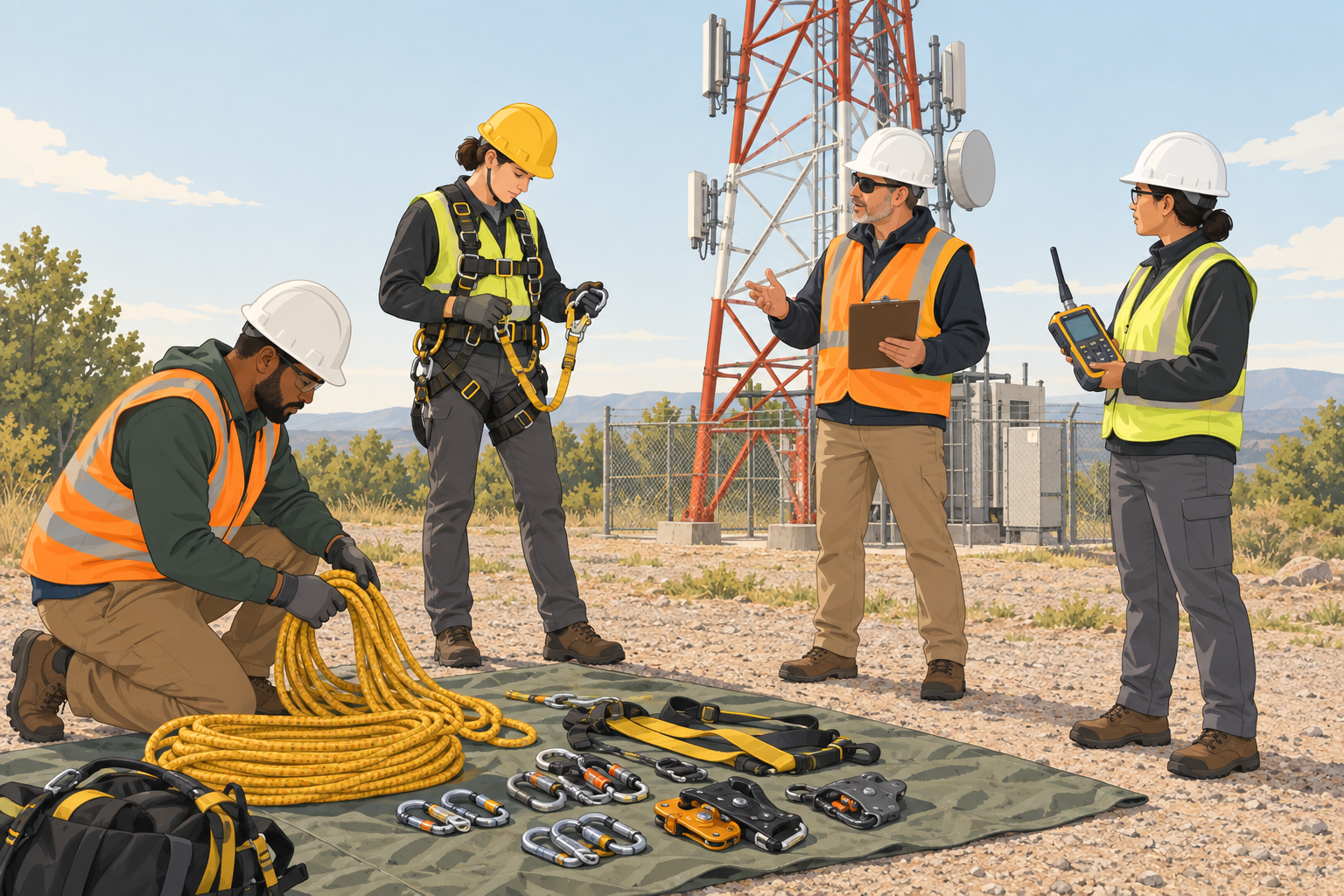
Nobody hires an untrained climber. Everybody hires ground hands. The ground crew stages gear, rigs loads, runs the tag line, holds the drop zone, and relays radio traffic to the climbers — no climb authorization needed to start. It's also how you learn the job by watching it instead of guessing. Search tower technician openings and apply for ground-crew and laborer postings specifically — "climber" roles in a listing usually mean "already certified," not "entry-level."
Step 5: Build toward TTT-1 once you're on a crew
Once you've got time on steel, the next real credential is NWSA's Telecommunications Tower Technician 1 (TTT-1) — a written exam plus a hands-on practical on a real tower. Our TTT-1 Exam Prep ($120, 9 hours) covers the written knowledge areas — job planning, 100% tie-off, rigging limits, structure types — but it's independent prep, not the NWSA exam itself. You still sit NWSA's written and practical to hold TTT-1. From there, rigging and crane-signal training round out what gets you handed more scope and better pay — see what certs actually move the number.
The physical and practical requirements nobody puts in the job posting
A few things trip up applicants before certs ever come into it. Most contractors require you to be able to climb and work while wearing a harness and gear that adds real weight — figure 20–40 lbs between the harness, lanyards, tools, and a hard hat — for hours at a time, in heat or cold. Drug testing, including random testing once you're hired, is standard across the industry because of the fall-hazard exposure. A valid driver's license matters even for ground roles, since crews often carpool or caravan to remote compounds in company vehicles. None of this requires prior experience, but showing up unprepared for it on day one is a common reason new hires don't make it past the first week.
What actually gets a new hand hired
Foremen aren't looking for someone who already knows tower work. They're looking for someone who won't need babysitting on the ground, won't panic the first time a load swings, and already has the entry certs so the crew isn't short a body on the next site checklist. Everything above is how you walk in with that covered.
Want a feel for the work before you apply anywhere? Run through Sector Swap — replace an RRU and a panel antenna on a sector, ground to close-out, free, no signup — or browse the rest of the free field tools.
Quick answers
Can I become a tower climber with zero construction background? Yes — most crews hire ground hands with no construction history at all. What matters is the entry certs, a clean-enough background check, and showing up reliable. Climbing authorization comes later, on the job.
How long does it take to get hired? The certs above (fall protection, RF, first aid) take about two and a half hours combined and cost around $119, plus OSHA 10 from an authorized provider. Hiring timelines vary by region and how much work carriers have queued.
Do I need to be certified to climb on day one? No. New hires almost always start as ground hands and earn climb authorization after their employer trains and evaluates them on-site — that part can't happen online.
What does the job pay starting out? We break down real first-year pay and per diem separately in tower climber first-year pay and per diem, explained — worth reading before you commit to relocating for a crew.