OSHA does not have one standalone standard titled "tool tethering," but it doesn't need one: the General Duty Clause (Section 5(a)(1) of the OSH Act) requires employers to keep a workplace free of recognized hazards, and a dropped tool from height is about as recognized a hazard as exists in construction and telecom work. In practice, that duty gets carried out through tool tethers, exclusion zones, and a documented dropped objects program — which is exactly what OSHA cites employers under when a falling tool causes an injury and no control was in place.
The confusion is understandable. Fall protection has its own detailed standard (1926.501), head protection has its own standard (1926.100), but "dropped objects" sits across both plus general duty — so there's no single citation number people can point to and say "that's the tool tether rule." ANSI/ISEA 121, the industry consensus standard for dropped object prevention solutions, fills that gap with specifics most OSHA inspectors reference: tether ratings, anchor points on tools, and container/containment requirements.
What Actually Stops a Dropped Object
There's a real hierarchy here, and it matters which level you're relying on:
A hard hat is none of these. It's rated to protect against incidental bumps and small debris, not a dropped wrench or drill from 80 feet — physics alone rules that out. Relying on hard hats as the dropped-object control is one of the most common findings when an incident gets investigated after the fact.
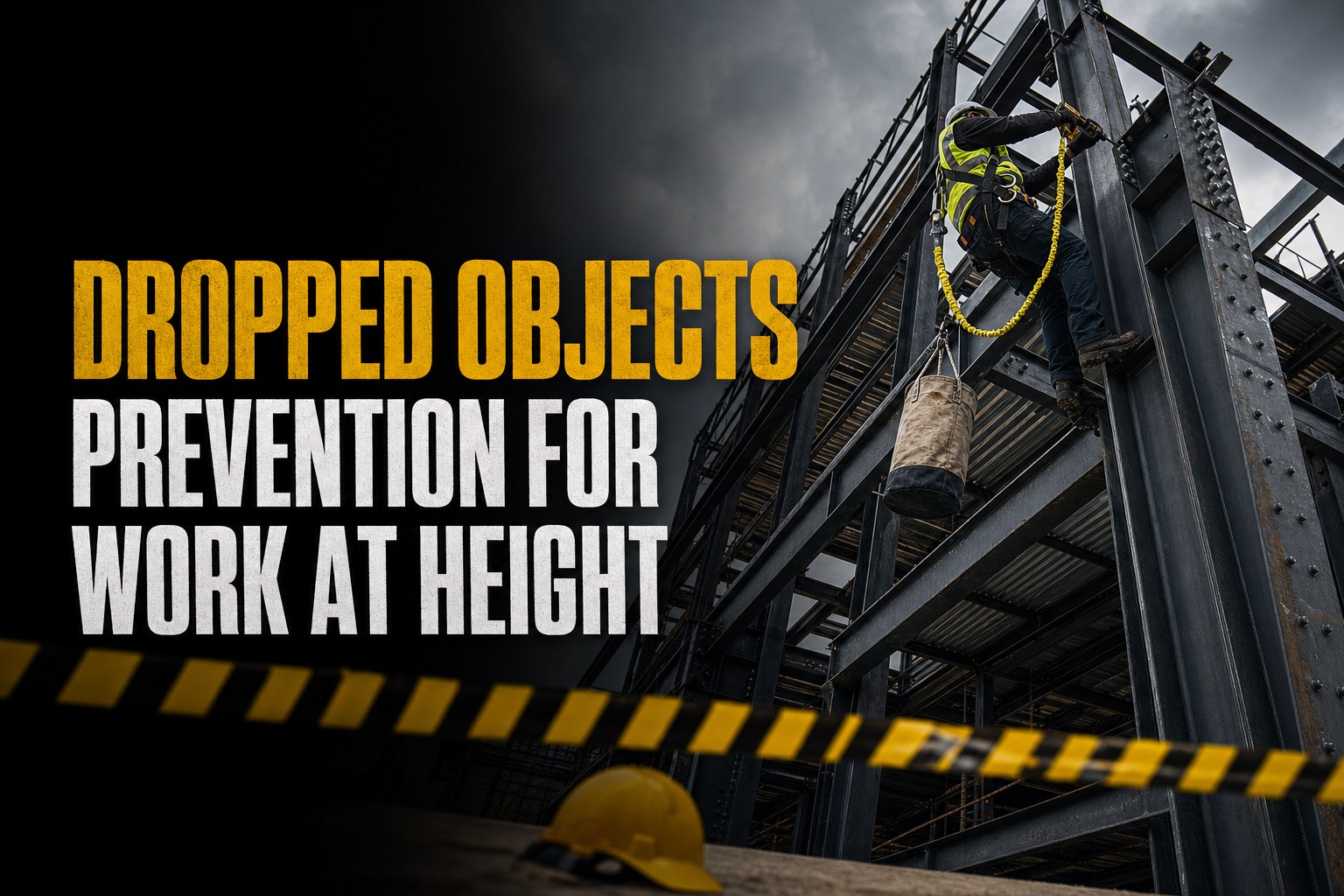
Recommended certification
Dropped Objects Prevention for Work at Height
$39 · ~2h online · certificate issued same day · valid 2 years
Also read: Preventing Trench Fatalities: Key Takeaways from NUCA's Safety Month · NATE's July Update: Growth, Safety, and What Climbers Need to Know
Tool Tethers and Their Ratings
A tool tether is only as good as its rating relative to the tool's weight and the anchor it's clipped to. ANSI/ISEA 121 rates tethers and anchor systems by working load, and most crews get this wrong in one of two ways: using a single lanyard rated for a hand tool on something heavier, or anchoring the tether to a point on the tool belt instead of a structural anchor point built for the purpose.
Controlling the Zone Below
Even a well-tethered crew needs a drop zone, because tethers fail and hardware gets dropped during setup and teardown, not just during active work. The zone has to be sized for the actual height of the work — not a flat 10-foot rule applied regardless of whether the work is at 15 feet or 150 — and it needs someone actively enforcing it, not just a sign. Ground crews working underneath a tower, roof edge, or scaffold are the people a dropped object program exists to protect, and they're also the easiest group to forget when planning focuses on the climber.
From a Rule to a Program
A single tethered drill doesn't make a dropped objects program. A real program documents what's allowed to go up the structure in the first place, inspects tethers and containment gear on a schedule, and tracks near misses as data — not as a story that gets told at the next safety meeting and forgotten. That last point matters more than it sounds: a tool that almost fell and didn't is the same failure as one that did, just without the injury, and it's the cheapest warning sign available.
What the Course Covers
BuildRight's Dropped Objects Prevention for Work at Height course ($39, about 2 hours) walks through all of this in order: what a falling object actually does at height, the remove-retain-arrest hierarchy, tool tether ratings and ANSI/ISEA 121, containers and containment, how to size and enforce a drop zone, and how to turn all of it into a documented, auditable program instead of a one-time toolbox talk. It ends with a final test and a certificate of completion. It pairs naturally with fall protection training for anyone working at height, and with PPE training for crews building out their full head-to-toe program.
Frequently Asked Questions
Is there an OSHA standard number specifically for tool tethers?
No single standard covers tool tethers by name. The requirement comes from the General Duty Clause combined with fall protection and PPE standards, and from ANSI/ISEA 121, which OSHA references as the recognized consensus standard for dropped object prevention equipment.
Are hard hats enough to protect workers from dropped tools?
No. Standard hard hats are rated for incidental impact, not for the force of a tool falling from height. Hard hats protect against a different hazard than dropped-object prevention programs address.
What is ANSI/ISEA 121?
It's the industry consensus standard covering dropped object prevention solutions — tool tethers, anchor points, containers and their rated working loads. It's the specification most tether and containment gear is tested and rated against.
Do I need a formal dropped objects program if my crew already uses tethers?
Tethers alone are equipment, not a program. A program adds documentation of what's allowed up the structure, inspection schedules for the gear, and a process for logging near misses — the pieces that let you prove the control is actually working.
Does this training apply outside of tower work?
Yes. Dropped object hazards exist on rooftops, scaffolding and any elevated construction work, not just towers — the course is written for tower, rooftop and general construction crews working at height.


