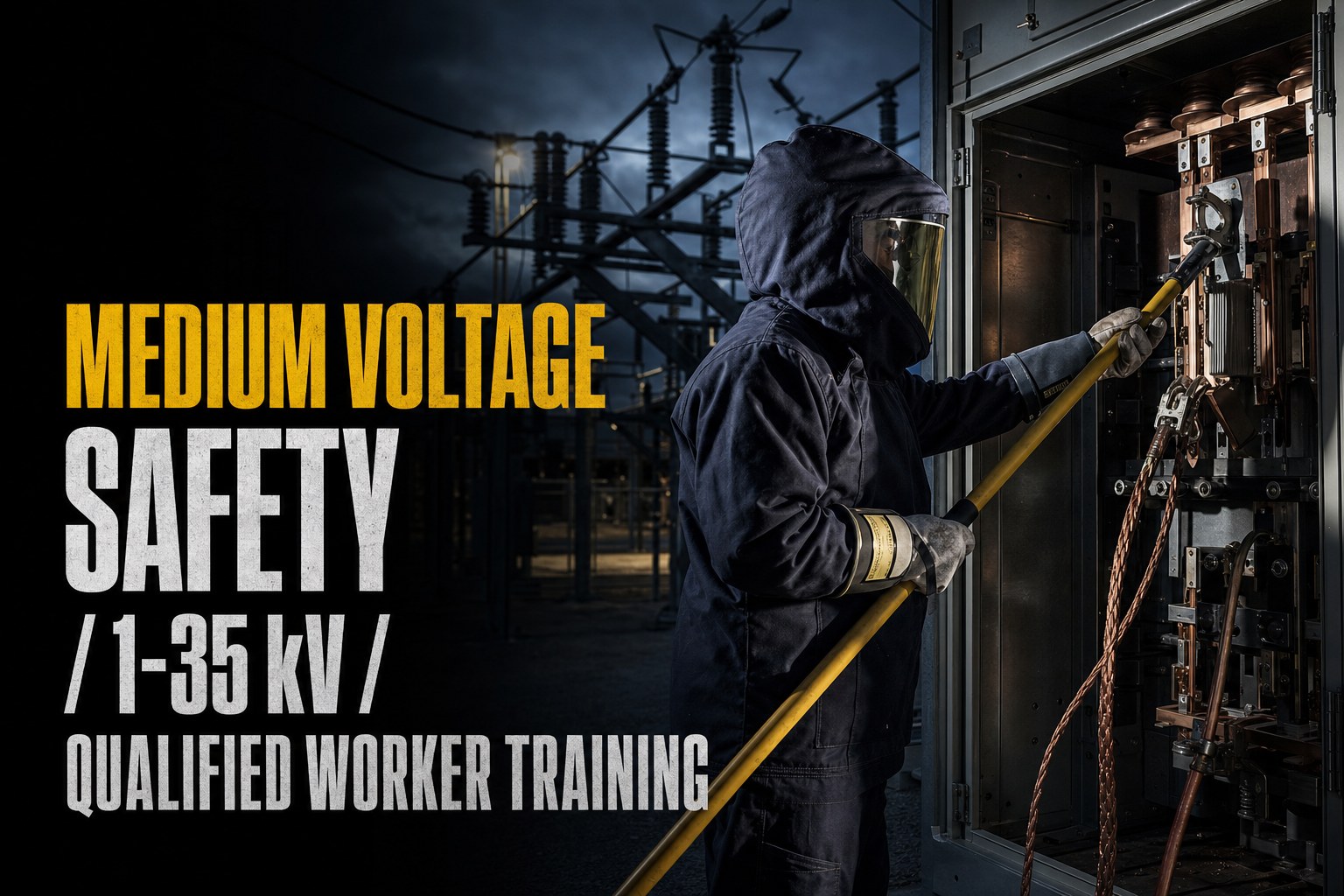
Medium voltage safety training is required under 29 CFR 1910.269 and NFPA 70E for any "qualified person" who works on or near exposed energized parts rated between 1,000 volts and 35,000 volts (1–35 kV). At these voltages, step and touch potential, arc flash boundaries, and test-before-touch procedures all work differently than they do on standard 120/240V circuits — training built for low-voltage electrical work does not cover them.
Utilities, substation crews, and telecom sites with medium-voltage feeds all fall under this. The standard doesn't hand out a credential — like OSHA's qualified electrical worker determination, the employer decides who is qualified, based on documented training for the specific voltage class and task.
What Counts as "Medium Voltage"
The industry generally splits electrical work into three voltage bands, and each one changes the hazard profile:
| Class | Range | What Changes |
|---|---|---|
| Low voltage | Under 1,000V | Standard electrical safety training (QEW) applies |
| Medium voltage | 1,000V – 35,000V | Step/touch potential, arc flash energy increase sharply, live-line tool use |
| High voltage | Above 35,000V | Utility-specific training, typically beyond site-level courses |
A worker qualified for low-voltage panel work is not automatically qualified for medium voltage — the approach boundaries, required PPE category, and even the tools (insulating gloves rated for the voltage class, live-line tools) are different.
What's Actually Different at 1–35 kV
- Step and touch potential — a person standing near a fault or a grounded conductor can be injured by voltage gradient in the ground itself, not just direct contact. This barely matters below 600V; it's a real hazard at medium voltage.
- Arc flash incident energy rises sharply with voltage and available fault current — the same mistake that causes a minor arc at 480V can be catastrophic at 15 kV.
- Approach boundaries (limited, restricted, and arc flash boundary) are calculated differently and are generally much larger than low-voltage boundaries.
- Test-before-touch and temporary protective grounding procedures are mandatory extra steps before any contact with de-energized medium-voltage equipment — "de-energized" still has to be verified, not assumed.
Who Must Be Trained
The employer makes the qualified-person determination — the same logic as OSHA's electrical qualified-worker rule (1910.332) applied to this voltage class specifically. In practice this covers substation technicians, utility and telecom linework near medium-voltage feeds, and any site electrician asked to work on padmount or switchgear equipment in that range. Being a licensed electrician does not by itself make someone qualified at medium voltage — the specific training has to have happened.
Required PPE at Medium Voltage
Arc-rated clothing sized to the calculated incident energy, voltage-rated insulating gloves with leather protectors, insulated/insulating tools, and face/eye protection rated for the arc flash category — selected from an arc flash risk assessment, not guessed at. The course covers how that PPE category is determined and why it's higher than a typical 480V job.
Common Compliance Gaps Inspectors Find
A few patterns show up repeatedly when medium-voltage sites get audited:
- Insulating gloves in use past their test date — rubber insulating gloves have a mandatory periodic electrical test (typically every 6 months), and a glove that looks fine visually can still fail that test. A log with the last test date has to exist, not just a glove bag.
- Grounding sets not rated for the voltage class — a temporary protective ground rated for 15 kV doesn't automatically cover a 25 kV feeder; the rating has to match the system.
- "De-energized" treated as self-evident — crews skip the test-before-touch step when a breaker is believed open, which is exactly the assumption the standard exists to remove.
- Training that covers low-voltage QEW content only — a worker trained for standard panel work but assigned to switchgear or padmount equipment without medium-voltage-specific training.
How Often Retraining Is Required
Neither OSHA 1910.269 nor NFPA 70E sets one universal retraining interval the way, say, CPR does — retraining is required whenever job duties, equipment, or procedures change, and most employers run a refresher on a 1–3 year cycle as a matter of policy. What's non-negotiable: if an employee is observed not following a safety-related work practice, or involved in an incident, retraining is required before they're allowed back on medium-voltage work.
What the Course Covers
BuildRight's Medium Voltage Safety (1–35 kV) — Qualified Worker Training course ($95, about 3.5 hours) covers step and touch potential, arc flash at medium voltage, approach boundaries, test-before-touch procedure, temporary protective grounding, and insulating gloves/live-line tool use — built to OSHA and NFPA 70E standards. It pairs naturally with Qualified Electrical Worker (QEW) for crews who also do low-voltage work, and NFPA 70E Arc Flash for a deeper arc flash-specific module. También disponible en español: Seguridad en media tensión.
Frequently Asked Questions
What voltage range counts as "medium voltage"?
Generally 1,000V to 35,000V (1–35 kV) — above standard low-voltage electrical work and below high-voltage utility transmission.
Does a state electrician's license cover medium-voltage work?
Not automatically. OSHA's qualified-person determination is based on documented training for the specific voltage class and task, made by the employer — a license alone doesn't satisfy it.
Why does arc flash matter more at medium voltage?
Available fault current and incident energy both scale up sharply with voltage, so the same type of mistake produces a far more severe arc flash event than it would at 480V or below.
What is "test before touch"?
A mandatory verification step confirming equipment is actually de-energized — using a rated tester, immediately before contact — even when the equipment is believed to already be locked out and grounded.
How is this different from NFPA 70E training?
NFPA 70E sets the arc flash risk-assessment framework used across voltage classes; this course applies it specifically to the 1–35 kV range, alongside the step/touch-potential and live-line-tool content that's unique to medium voltage.