Electrical Safety Bundle: QEW, NFPA 70E and Medium Voltage Training
The three courses that cover a worker from a 480 V panel to a 35 kV switch — who counts as qualified, the standard the practices come from, and what changes above a kilovolt. One purchase, one invoice, three certificates of completion. Built to OSHA standards.
$71 less than the three courses separately (27%)
One-time payment · lifetime access to each course
Who this is for
Crews whose work crosses more than one voltage class, and the people who have to prove that training happened. An electrician qualified on a 480 V panel is not automatically qualified at 15 kV; a maintenance tech who has never read NFPA 70E can still be the person who opens the cabinet. Electrocution stays one of construction’s Fatal Four, and arc flash injuries reach people whose job title says nothing about electrical work.
It is bought most often by industrial maintenance and plant teams with customer-owned medium voltage on site, by telecom and data centre crews working from the primary metering down to the rectifier, by utility contractors, and by safety managers who need one purchase, one invoice, and a training record per worker rather than three orders and a spreadsheet.
What each course closes
Three similar titles at similar prices is the reason people buy none of them. Here is the question each one answers, and when it is the only one you need.
- 01The person
Qualified Electrical Worker (QEW) — Electrical Safety Compliance Training
What a qualified electrical worker is, and the two things an employer needs before designating one: documented training and demonstrated skill on the equipment. Shock and arc flash hazards, risk assessment, approach boundaries, the arc flash PPE category method, energized versus de-energized work and LOTO, and first response to an electrical injury.
Take it alone if your paperwork says “qualified electrical worker” and the work is below 1,000 volts.
- 02Above a kilovolt
Medium Voltage Safety (1–35 kV) — Qualified Worker Training
What changes from 1 kV to 35 kV: step and touch potential, incident energy in a different class, stored and induced energy, OSHA 1910.269 and 1926 Subpart V, minimum approach distance and where its numbers come from, switching orders, test before touch, temporary protective grounding, rubber glove classes and live-line tools, vaults and manholes.
Take it alone if you work distribution gear and already hold current low-voltage training.
- 03The standard
Electrical Safety & Arc Flash Training — NFPA 70E® (2027)
NFPA 70E itself: the electrical safety program and training duties in Article 110, the three-year retraining interval, the shock and arc flash risk assessment procedure, incident energy and how PPE is chosen against it, and what has to be on an energized electrical work permit before anyone signs it.
Take it alone if a contract or a GC asks for “NFPA 70E training” by name.
Why the three together beat the three separately
One decision
The hardest part of buying electrical safety training is working out which of the overlapping courses you actually need. The set removes the question: it is the whole ladder, from who counts as qualified up to distribution gear, decided for you.
No gap at the seam
Incidents cluster at the boundary between what a worker was trained on and what they were sent to do. Buying one course leaves the seam where the next voltage class or the next standard begins; buying the set covers both sides of it.
One record, one invoice
3 certificates of completion per worker, each verifying online by its own code, all under one order. For a crew, seats are assigned from the team dashboard and completion is visible without chasing anyone for a PDF.
The saving is real but it is not the argument: $71 off $260. The reason to buy the set is that it is the set.
What's in the bundle
All electrical safety courses →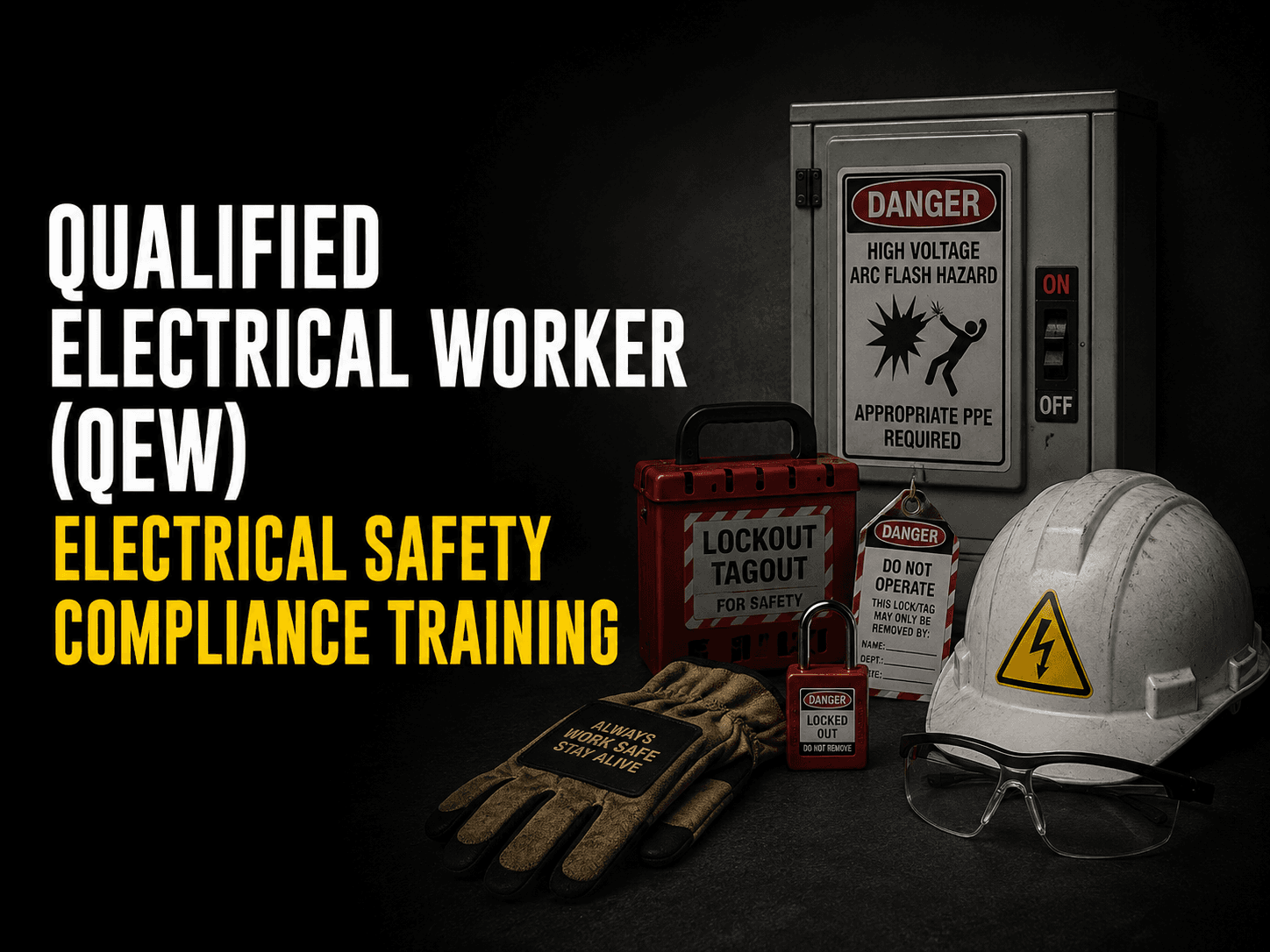
Qualified Electrical Worker (QEW) — Electrical Safety Compliance Training
Electrical safety training built around NFPA 70E: shock and arc-flash risk assessment, approach boundaries, PPE selection, the electrically safe work condition and energized work permits. Covers what a qualified electrical worker has to know — and who actually designates one.
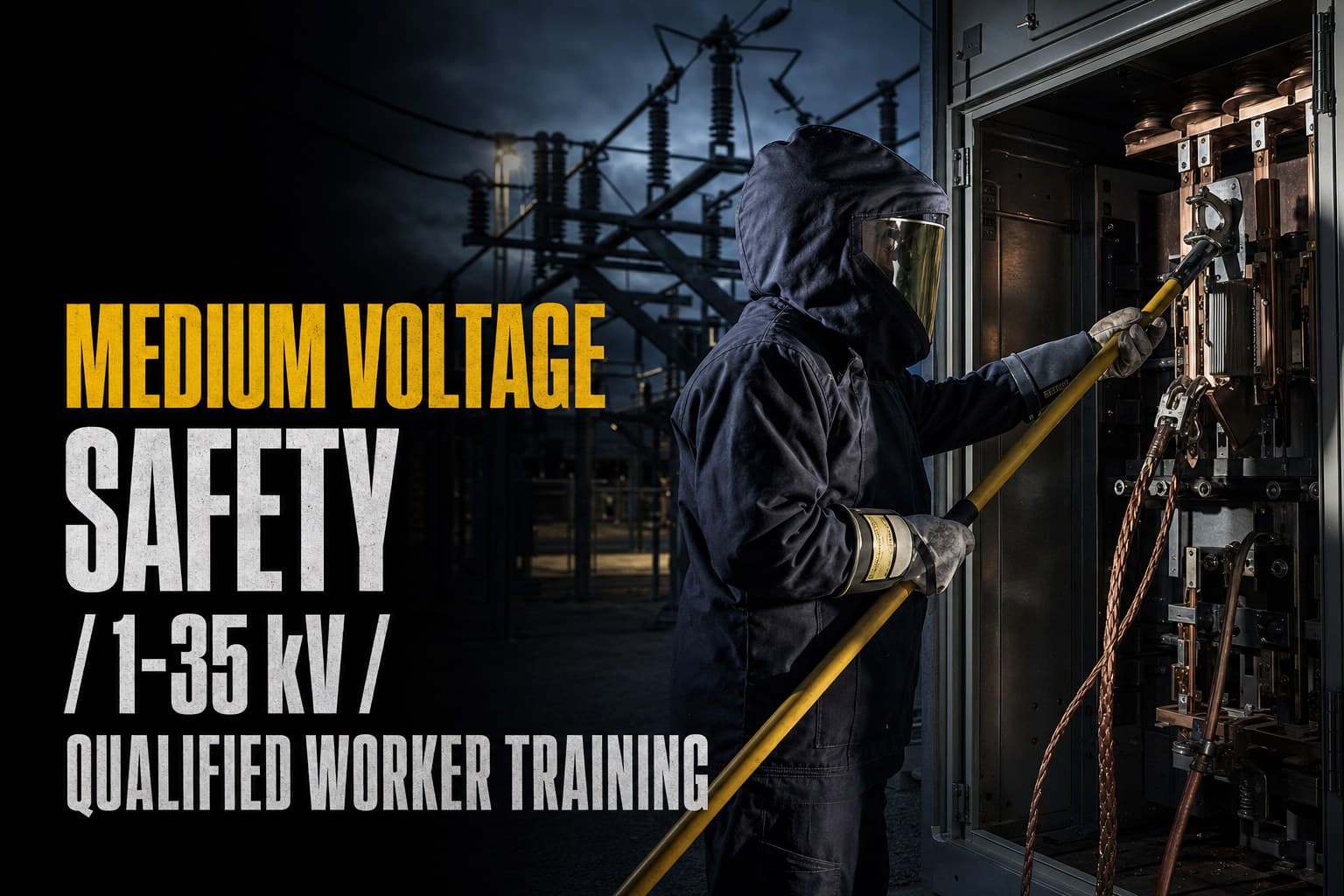
Medium Voltage Safety (1–35 kV) — Qualified Worker Training
Work safely around 1–35 kV. Step and touch potential, arc flash at medium voltage, approach boundaries, test before touch, temporary protective grounding, insulating gloves and live-line tools. Built to OSHA standards.

Electrical Safety & Arc Flash Training — NFPA 70E® (2027)
Build and work inside an electrical safety program to NFPA 70E: the electrically safe work condition, shock and arc flash risk assessment, approach boundaries, PPE selection, energized work permits, training and program audits. Built to OSHA standards.
Training a whole crew on this?
Buy seats once, assign all three courses to each worker, and watch completion in real time. One invoice, and a certificate roster with QR codes to hand a site checker instead of chasing 12 PDFs across a crew of four.
Frequently asked questions
Why three courses instead of one?
Because they answer three different questions, and no single course answers all three without being too long for anyone to finish. The QEW course is about the person and how an employer designates one. NFPA 70E is the standard those practices come from, in the detail a safety program needs. Medium Voltage Safety is about what changes above 1,000 volts, where the governing regulation shifts and the numbers stop transferring. A crew that works both sides of a transformer needs all three; a crew that never opens a pad-mount needs the first two.
Do the courses repeat each other?
They overlap on purpose in three places: arc flash, approach boundaries and PPE. Each one treats them from its own angle — the qualified person, the standard, and the medium voltage case — because most people buy one course, not three, and none of them can afford to leave those subjects out. Taken together the repetition is the point: it is the same material seen three times from three positions, which is closer to how it is learned on site than a single pass would be.
What order should I take them in?
Qualified Electrical Worker first — it sets the vocabulary the other two use. NFPA 70E second, because it is the standard behind what you have just learned and goes deeper on assessment and permits. Medium Voltage Safety last, since it assumes you are comfortable below a kilovolt before it takes you above one. Nothing enforces that order; all three unlock at once and stay in your account.
Do I get a separate certificate for each course?
Yes. Each course issues its own certificate of completion the same day you pass its final test, with a unique code that verifies online. Three courses, three certificates, three separate expiry dates — which is what a site checker or a prequalification packet expects to see.
Are these courses OSHA-approved or NFPA-certified?
No provider’s courses are. OSHA does not approve, accept or certify training outside its own Outreach program (the OSHA 10/30 DOL-card system), and the NFPA publishes the 70E standard without certifying courses or people. These are independent BuildRight Academy courses built to OSHA and NFPA 70E standards, and what you receive are certificates of completion that verify online by their own codes. Whether they satisfy a given site is the employer’s or site owner’s decision.
Does the bundle make my crew qualified?
It delivers and documents the training half. Both OSHA and NFPA 70E leave the designation of a qualified person with the employer, judged on the specific equipment and task — someone can be qualified on one panel and unqualified on the switchgear beside it. What the bundle gives you is the training record behind that decision, verifiable online, for every worker you assign it to.
Can I buy it for a whole crew?
Yes, and it is the cheaper way to do it. Buy seats once from the team dashboard, assign the courses to each worker, and watch completion in real time. You get one invoice and a certificate roster with QR codes to show a site checker, instead of chasing eleven people for PDFs.
How long do the certificates last?
Two years each, verifiable online by code for that whole period, and we email you before they expire. NFPA 70E asks for retraining at intervals not exceeding three years; two years is the interval most employers and site owners actually run, and it leaves room for the triggers that shorten it — a change of job, new equipment, or an audit that finds practices have drifted.