Under 29 CFR 1926.1427, mobile crane operators on construction sites must be certified by an accredited crane operator testing organization or qualified through an audited employer program before operating independently — and the certification path requires passing both a written core exam and a practical exam. The written exam tests the operator's knowledge, not their hands-on ability, which is exactly where most candidates underprepare: they practice on the machine and skim the written material, when the two exams test genuinely different skill sets.
This article is about what the written core exam actually covers and how to study for it — not about which specific testing organization to use, since that choice depends on your state, your employer's program, and which organizations are accredited in your area. The content of the written exam is built around the same core body of knowledge regardless of which accredited organization administers it.
What the Written Core Exam Actually Tests
Site layout and setup
Reading a site before the crane even arrives — ground conditions, where outriggers can safely bear load, and the assembly/disassembly process overseen by a qualified A/D director. Power line awareness during setup is its own heavily tested area, because setup-phase line contact is one of the most common serious incidents in crane work.
Crew roles, signals and procedure
Who does what on a lift, the standard hand signal method, radio and voice communication protocols (especially with multiple cranes on one site), and the full operating sequence from pre-lift through shutdown.
Technical knowledge: stability and load weight
Why cranes tip — center of gravity and stability margins — plus determining load weight correctly, including the common "75% rule" guidance for working within a safe margin of rated capacity, and how wind and environmental conditions reduce that margin further.
Reading a load chart
This is the section that separates prepared candidates from unprepared ones. The exam expects you to read the anatomy of a load chart, work a net capacity calculation step by step, understand parts of line and reeving, and read a range diagram to determine the crane's actual reach envelope for a given configuration.
Recommended certification
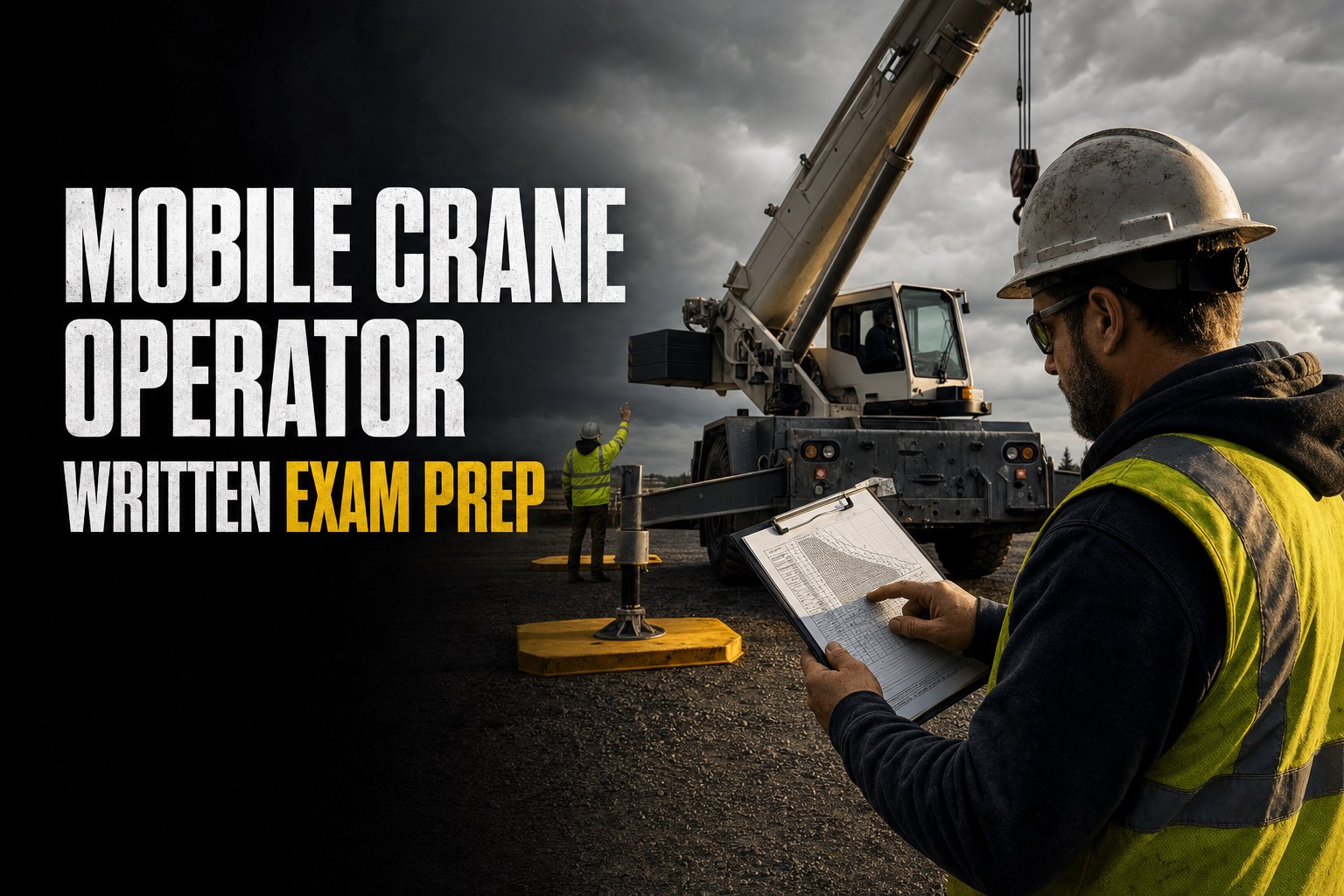
Mobile Crane Operator Written Exam Prep
$99 · ~8h online · certificate issued same day · valid 2 years
Also read: Breland Homes Faces $115,855 OSHA Penalties After Fatal Trench · Preventing Trench Fatalities: Key Takeaways from NUCA's Safety Month
OSHA 1926 Subpart CC essentials
The written exam draws heavily on the standard itself: power line clearance requirements (including Table A and the three compliance options), ground condition and assembly/disassembly rules, the required inspection schedule (shift, monthly and annual), signal requirements under the standard, and the operator qualification requirements that created the certification pathway in the first place.
How to Actually Study for It
A large, well-organized practice question bank matters more for this exam than for most written tests, because load chart problems and stability questions are skill-based — repetition with explanations is what builds the pattern recognition needed to work through a net capacity problem quickly under exam conditions. Studying should move through site/setup, crew roles and signals, technical/stability knowledge, load charts, and the Subpart CC standard itself, then finish with full-length timed practice that mimics the real exam format.
What the Course Covers
BuildRight's Mobile Crane Operator Written Exam Prep course ($99, about 8 hours) is verified independent study material built around exactly this structure: site layout and setup, crew roles and signals, stability and load weight, worked load chart examples, the OSHA 1926 Subpart CC essentials, a large practice question bank organized by topic (site/setup, technical/rigging, load charts, and the standard itself), and a full-length final exam. It is independent preparation material — not affiliated with or endorsed by any certifying organization, and completing it is not itself a crane operator certification.
This course is currently in final review before publication and isn't open for enrollment yet. Crews preparing for crane work should also look at rigging training for the load-handling fundamentals the written exam assumes, and can get a feel for stability and load charts hands-on with the free crane simulator.
Frequently Asked Questions
Does completing a written exam prep course make me a certified crane operator?
No. Certification requires passing both a written and a practical exam through an accredited testing organization (or qualifying through an audited employer program), per 29 CFR 1926.1427. A prep course builds the knowledge for the written portion only.
What's on the written core exam?
Typically: site layout and setup, crew roles and signals, technical knowledge including stability and load weight, load chart reading, and the OSHA 1926 Subpart CC requirements governing crane operations.
How is load weight determined before a lift?
Through a combination of documentation (shipping weights, engineering data) and standard estimation methods when exact weight isn't available — with a safety margin, commonly referenced as the "75% rule," built in to account for uncertainty.
Is the written exam the same regardless of which organization administers it?
The underlying body of knowledge — site setup, signals, stability, load charts, and the OSHA standard — is consistent across accredited testing organizations, since all of them test against the same regulatory and technical foundation, even though specific exam formats vary.
Do I need crane rigging knowledge before taking this course?
Basic rigging concepts (slings, working load limits, sling angle) appear in the technical knowledge section, but a dedicated rigging course builds that foundation in more depth if you're new to rigging specifically.

