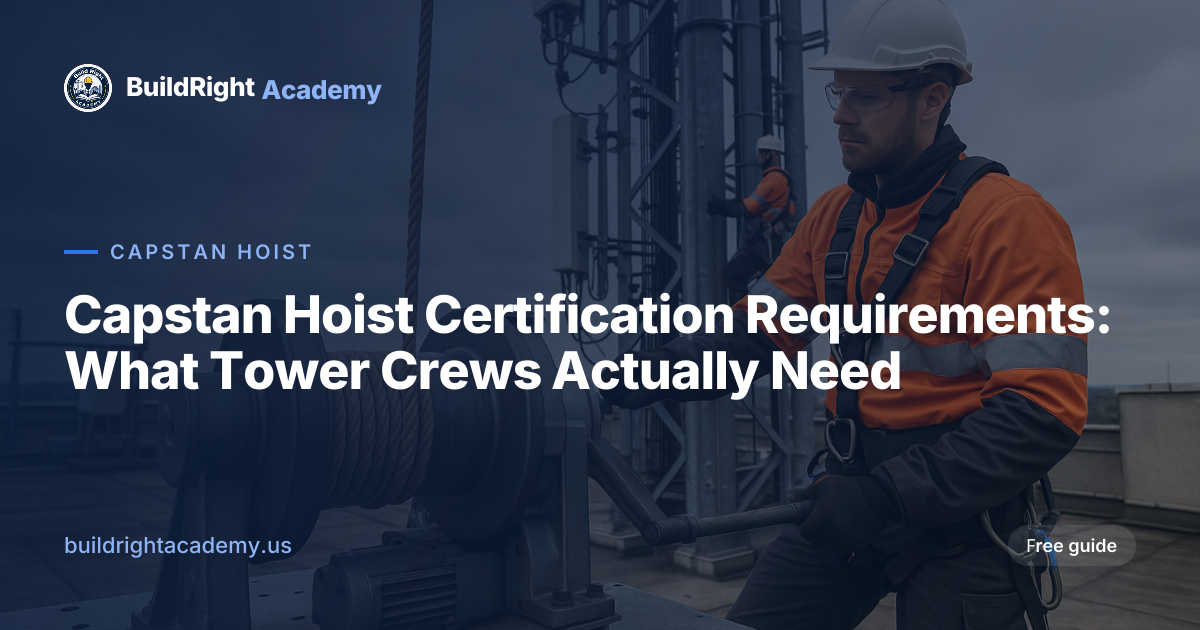
Ask five foremen what capstan certification the site requires and you will get five different answers. The confusion is understandable: there is no single federal "capstan hoist license." What exists instead is a patchwork of OSHA general-duty requirements, manufacturer training expectations, and carrier site-access rules — and the carrier rules are the ones that actually stop crews at the gate.
The short answer
- OSHA does not name capstan hoists in a dedicated standard. They fall under general rigging and material-handling requirements: the operator must be trained and competent for the equipment they use, and the employer must be able to prove it.
- Carriers and tower owners are stricter. On most telecom sites at least half the crew is expected to hold current capstan hoist training alongside battery and hazcom awareness, and gate audits do ask for the certificates.
- Manufacturers (the people whose name is on the hoist) require training per their manual — and after an incident, "was the operator trained per the manufacturer's instructions" is the first question an investigator asks.
What inspectors and carriers actually check
When a crew checks in at a telecom site, the compliance package typically gets screened for:
None of that comes from one law. It comes from the contract chain: the carrier writes requirements into the master service agreement, the turf vendor passes them down, and the GC enforces them at the gate.

Recommended certification
Basic Rigging Principles on Communication Structures
$95 · ~4.5h online · certificate issued same day · valid 2 years
Also read: Competent Climber vs Authorized Climber: What’s the Difference on Tower Sites? · RF Awareness vs RF Safety Training: What’s the Difference and Which Do You Need?
Who on the crew needs it
A practical rule that matches what carriers audit: every worker who operates or rigs to the capstan needs training, and most site checklists want at least 50 % of the crew current on capstan, battery safety, and hazcom. Sending one certified operator with three untrained helpers is exactly the split that fails an audit.
What the training has to cover
A capstan course worth its certificate covers rated line pull versus wraps, rope selection and inspection, anchoring the hoist, load control and hand positioning, communication between the operator and the tag line, and the failure modes — overwrapping, riding the rope, and shock loading. If a course does not touch those, the certificate will not survive an incident review.
Try it: Rigging Lab — a free sling-angle and block-load tool. No signup.
How to get certified without losing a crew day
Classroom capstan courses exist, but for the operator-knowledge portion most carriers accept online training with a verifiable certificate. Our capstan hoist safety course takes about an hour, issues the certificate the same day, and every certificate is verifiable online — which is what the gate check actually wants to see. The hands-on familiarization with your specific hoist stays with your competent person on site, exactly as the manufacturer's manual describes.
Bottom line
There is no capstan license to chase — there is an evidence package to keep current: named operator certificates, readable equipment labels, and a crew ratio that survives a gate audit. Keep those three in order and capstan compliance stops being the thing that holds your crew in the parking lot.