Whether you legally need flagger certification depends on your state — there is no single federal flagger card. MUTCD (the Manual on Uniform Traffic Control Devices) Part 6 sets the national technical standard for temporary traffic control and flagger procedure, but individual states decide whether flaggers must hold a specific state-approved certification before working a roadside or access-road work zone. Some states require it outright, some leave it to the employer, and some only require it on state DOT-controlled roadways.
This is the single most common point of confusion for crews doing short-duration roadside work — including telecom crews controlling traffic at access roads and small cell sites, who don't always think of themselves as "flaggers" in the traditional highway-construction sense, but are performing the exact same function under the exact same standard.
What MUTCD Part 6 Actually Covers
Part 6 is the rulebook behind every cone, sign and taper in a temporary traffic control zone — it defines the zone's four areas (advance warning, transition, activity, and termination), buffer space requirements, and the standard STOP/SLOW paddle signals and their meanings. It also sets expectations for the flagger station itself: where a flagger stands relative to traffic, sight distance requirements, and the high-visibility apparel class required (Class 2 for most daytime work, Class 3 for higher-speed roads or nighttime work).
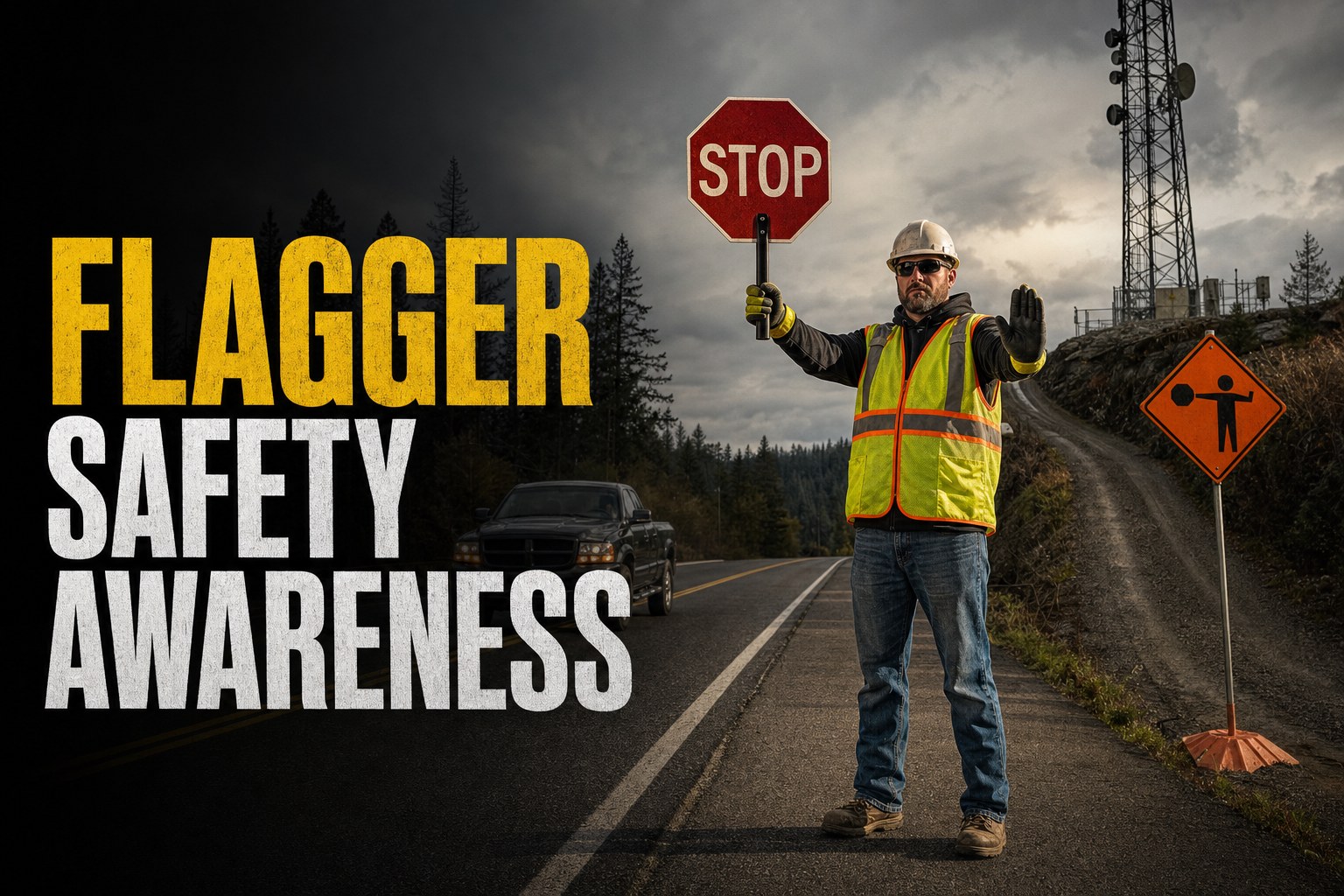
Recommended certification
Flagger Safety Awareness
$39 · ~1.5h online · certificate issued same day
Also read: Breland Homes Faces $115,855 OSHA Penalties After Fatal Trench · Preventing Trench Fatalities: Key Takeaways from NUCA's Safety Month
Where Crews Get This Wrong
Assuming "short duration" means no rules apply
A quick lane closure to let a bucket truck through still falls under the same zone, buffer space and signal requirements as a longer closure — MUTCD doesn't have a time-based exemption for the core safety rules, even though it does have simplified procedures for genuinely short-duration work.
Treating access roads and small cell sites as exempt
Flagging on a private access road or at a small cell pole site can still fall under MUTCD and state requirements if it affects public traffic flow, even briefly. Crews who only associate "flagging" with highway construction often miss this.
Confusing awareness training with a state card
An orientation-level course that teaches the zone layout, signals and PPE requirements is valuable and necessary — but if your state requires flaggers to hold a specific approved provider's certification to legally flag on a public roadway, awareness training doesn't replace that card. The two serve different purposes: one builds understanding, the other satisfies a specific legal requirement where one exists.
Night Work and Mobile Operations Change the Rules Further
Visibility requirements, lighting and signal timing all shift after dark, and mobile or short-duration operations (common on access roads to telecom sites) have their own adjusted procedures under MUTCD rather than simply scaling down the fixed-zone rules.
What the Course Covers
BuildRight's Flagger Safety Awareness course ($39, about 1.5 hours) is an awareness-level orientation covering MUTCD Part 6 basics, the temporary traffic control zone's four areas and buffer space, the flagger station and STOP/SLOW paddle signals, high-visibility apparel classes, communication between flaggers, night work, and short-duration and mobile operations — including scenarios specific to access roads and small cell sites. It explicitly does not replace a state-required flagger certification or an approved provider's card where one is legally required.
This course is currently in final review before publication and isn't open for enrollment yet. It pairs well with general construction safety training for crews whose work regularly puts them near live traffic.
Frequently Asked Questions
Is flagger certification required by federal law?
Not directly — MUTCD Part 6 sets the national technical standard for flagging procedure, but whether a specific certification or card is legally required is decided state by state, not by a single federal mandate.
How do I find out if my state requires flagger certification?
Check your state Department of Transportation's requirements, since states that adopt MUTCD can add their own certification mandates on top of it. Your employer's safety program should also specify what's required for the specific roads or sites you work.
Does this awareness course satisfy a state flagger certification requirement?
No. This is awareness-level orientation training and explicitly does not replace a state-required flagger certification or an approved provider's card. Check your state's specific requirement before relying on any course as a substitute.
Do telecom crews doing short-duration access road work need flagger training?
If the work affects public traffic flow, even briefly, the same MUTCD-based zone, signal and PPE requirements generally apply — "short duration" changes the procedure, not whether the standard applies at all.
What's the difference between Class 2 and Class 3 high-visibility apparel for flaggers?
Class 2 covers most daytime flagging on lower-speed roads; Class 3 is required for higher-speed roadways and nighttime work, where greater visibility distance and body coverage are needed. Your state or site requirement determines which applies.
What should a flagger do if a driver doesn't stop?
Move to the pre-planned escape route rather than standing ground — this is exactly why the flagger station and an identified escape path are set before traffic starts moving through the zone, not improvised after something goes wrong.

