Yes — OSHA's fall protection trigger under 1926.501 applies on a rooftop antenna site the same way it applies on any elevated construction work: once a worker is exposed to a fall of 6 feet or more to a lower level, fall protection is required, regardless of whether the surface feels like "height." A roof with a chest-high parapet can feel safe enough to walk without a harness; the standard doesn't make that distinction.
This is the single most common gap on rooftop antenna and DAS work. Crews that would never skip a harness on a guyed tower will walk an unprotected roof edge without a second thought, because a flat roof doesn't trigger the same instinct a 200-foot climb does. The hazard is identical under the standard — the psychology around it isn't, and that mismatch is exactly where incidents happen.
Why a Roof Doesn't Feel Like a Tower
A few things combine to make rooftop work feel lower-risk than it is:
- No climb. Getting to a rooftop antenna site usually means an elevator or a stairwell, not a ladder climb that keeps height top of mind the entire way up.
- A false sense of containment. Parapets, HVAC units and mechanical screening create visual barriers that feel protective even when they're not rated for fall arrest.
- Shared, "normal" space. Rooftops often host other building systems and get walked by maintenance staff in regular clothes — which can make PPE feel like overkill rather than standard practice.
None of that changes the physics of a fall, and none of it changes what 1926.501 requires.
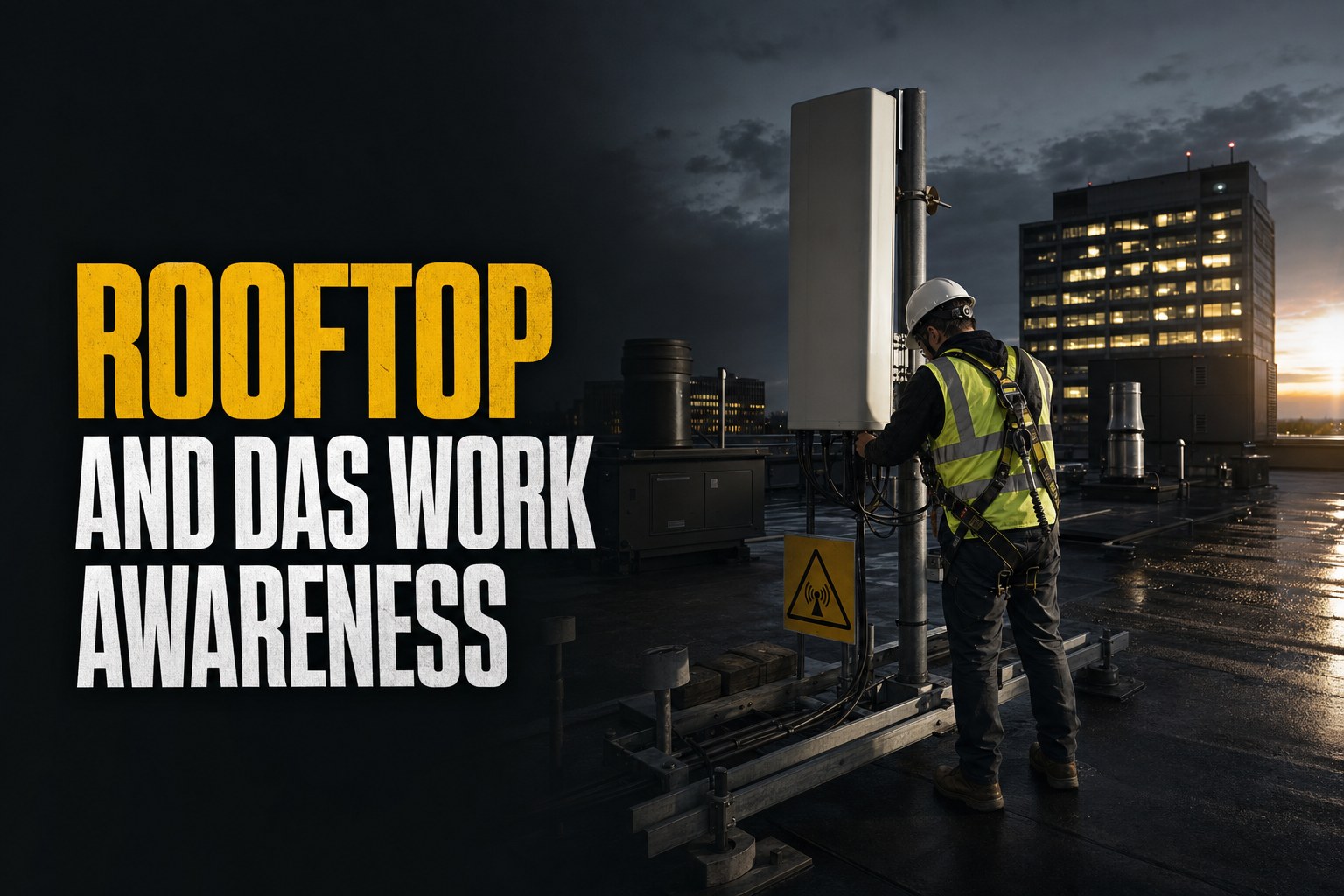
Recommended certification
Rooftop and DAS Work Awareness
$69 · ~2.5h online · certificate issued same day · valid 2 years
Also read: NATE's July Update: Growth, Safety, and What Climbers Need to Know · Competent Climber vs Authorized Climber: What’s the Difference on Tower Sites?
What Actually Triggers the Requirement on a Roof
- Unprotected edges and skylights — any edge without a compliant guardrail, and any skylight that isn't covered or guarded, counts as a fall hazard regardless of how far from the edge the work is happening.
- Leading-edge and low-slope roof work — OSHA has specific provisions for low-slope roofs that allow a safety monitor system under narrow conditions, but that's an exception, not a default.
- Working near a roof edge to service an antenna or mount — if the task puts a worker within 6 feet of an unprotected edge, fall protection applies even if the worker never intends to get closer.
Systems That Actually Work on a Roof
Towers lean on safety climb systems built into the structure. Roofs need something different: anchor points rated for fall arrest (not a rooftop unit's frame or a conduit run), horizontal lifelines for work that moves along an edge, and — where the roof layout allows it — guardrail systems that eliminate the fall hazard rather than just arresting it. Davit arms and ballasted mounts used for hoisting equipment have their own rated capacity that's separate from fall-arrest anchor points, and conflating the two is a common and dangerous mistake.
RF Adds a Second Layer
Rooftop antenna sites usually put RF sources at head height instead of far overhead the way a tower does, which changes exposure assessment and where controls (signage, power-down coordination) need to go. Fall protection and RF awareness are two separate hazards that happen to live on the same roof, and a rooftop-specific course has to cover both — a generic fall protection class built around towers or scaffolding won't touch the RF half at all.
What the Course Covers
BuildRight's Rooftop and DAS Work Awareness course ($69, about 2.5 hours) is built around exactly this gap between tower training and rooftop reality. It covers getting access and permission on someone else's roof, fall hazards specific to roofs (edges, parapets, skylights, and the systems that actually work on them), RF at head height and the controls that work for it, and the added layer of working DAS and small cell equipment inside occupied buildings. It finishes with a final test and a certificate of completion.
For crews climbing towers and working rooftops, pair it with fall protection training for the general standard, and check your exposure with the free RF hot zone tool before committing to a day's work plan.
Frequently Asked Questions
Does OSHA's fall protection requirement apply differently on a roof than on a tower?
No — the trigger is the same 6-foot threshold under 1926.501. What changes is the system used to comply: towers typically use safety climb systems built into the structure, while roofs rely on rated anchor points, horizontal lifelines or guardrails.
Is a rooftop parapet wall considered fall protection?
Only if it's been engineered and verified to meet OSHA's guardrail strength and height requirements. Most architectural parapets are not rated for this and should not be relied on as a fall protection system.
Do I need fall protection if I'm working in the middle of a large roof, away from the edge?
If the task doesn't bring you within 6 feet of an unprotected edge or opening, the fall protection trigger generally doesn't apply to that specific location — but skylights, roof hatches and equipment openings can create the same hazard well away from the perimeter.
Is RF exposure a bigger concern on a roof than on a tower?
It's a different concern, not necessarily bigger. Rooftop antennas often sit at head height rather than far overhead, which changes how exposure gets assessed and where power-down coordination needs to happen before work starts.
Can I use the same fall protection training for tower work and rooftop work?
General fall protection training covers the shared standard, but rooftop work has its own access, permission and hazard considerations — including RF at head height and working inside occupied buildings for DAS — that a tower-focused course won't cover.