Among the three national carriers, crews describe T-Mobile as the unpredictable one: some markets wave you through, others audit the whole compliance binder at the gate. The way to survive both is to show up with the full package every time.
The T-Mobile-specific item: TT-1
The requirement that separates T-Mobile from the others is TT-1 tower training coverage on the crew — most markets expect at least 50 % of the crew to hold it. If your crew is new to T-Mobile work, sort this first, because it is the one certificate you cannot substitute with a generalist course.
The universal package (T-Mobile checks it too)
The rest of the T-Mobile gate check mirrors what AT&T and Verizon expect on their sites:
- RF awareness — every worker, no exceptions. RF is the one certificate checked on 100 % of telecom crews. Anyone without it stays on the ground, at best.
- Fall protection / competent climber coverage — at least half the crew current as competent climbers, and the same ratio for competent rigger when the scope includes rigging.
- First aid + CPR — at least 50 % of the crew, and auditors increasingly want evidence of a practical (hands-on) component, not just a slideshow.
- Hazard communication, battery safety and capstan hoist training on at least half the crew.
- Crane signal certification whenever a crane is on the lift plan — nearly every carrier asks for it.
- Electrical qualification (QEW or equivalent) for anyone touching power systems.
Recommended certification
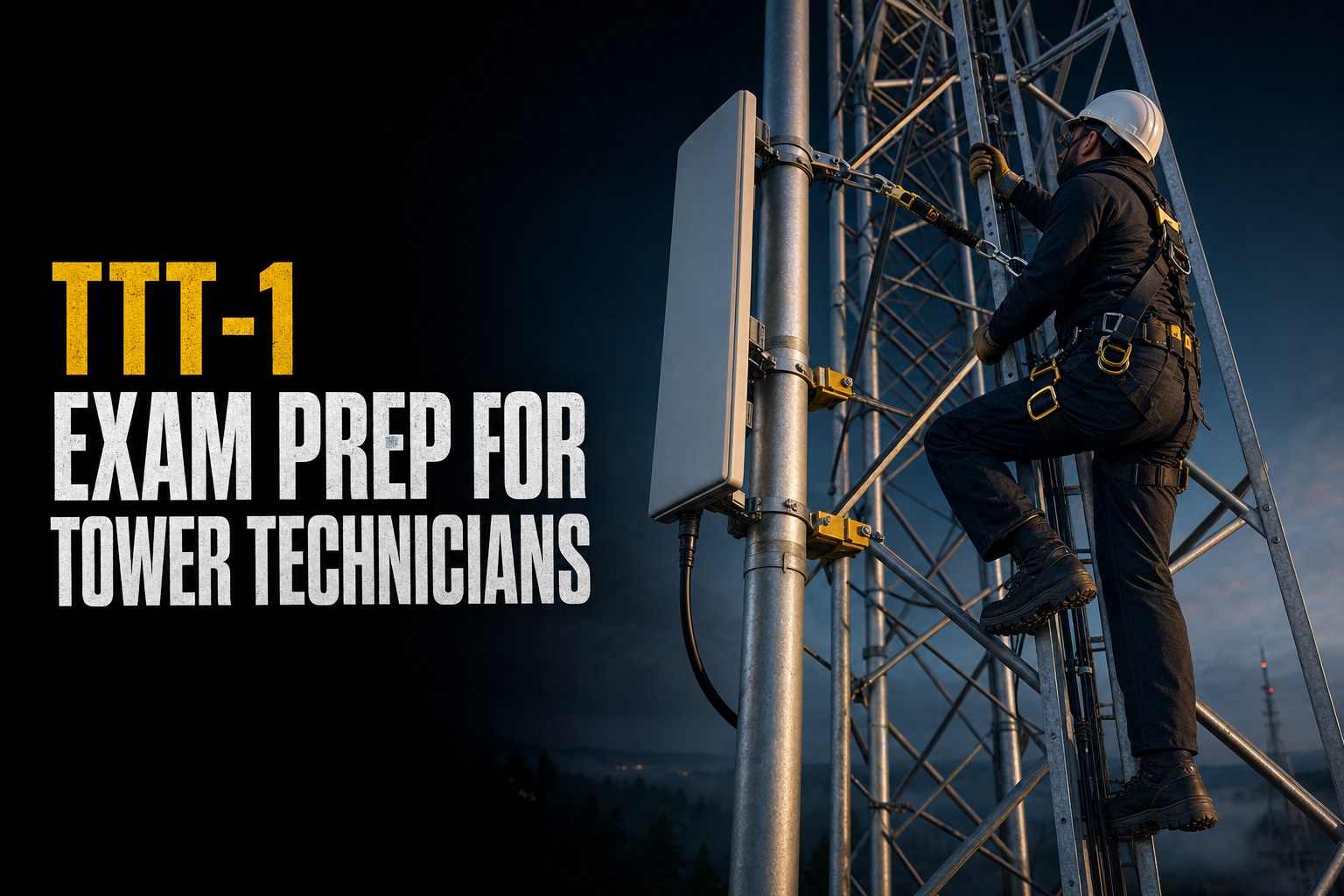
TTT-1 Exam Prep: Telecommunications Tower Technician 1
$120 · ~9h online · certificate issued same day · valid 2 years
Also read: What Certifications Do You Need to Work on Verizon Cell Sites? · Detroit Cell Site Battle: Why Clear Easements Matter for Tower Crews
Beyond certificates: what else stops crews
Certificates are only half of the check-in. T-Mobile sites also expect:
- Complete PPE — full personal fall arrest system, hard hat, safety-toe boots, and equipment slings; a missing hard hat sock or a torn lanyard keeper reads the same as a missing certificate to an auditor — the full list is in 9 things that get crews turned away.
- A calibrated RF monitor on the crew — an uncalibrated one is a documented turn-away.
- A job safety analysis (JSA) for the day's scope, signed by the crew.
- Check-in on three systems: the carrier's own portal, the tower owner's system (Crown Castle, American Tower, SBA), and the GC or turf vendor's log. Skipping one of the three is the most common "we did everything right and still got flagged" story.
Mount work: one more layer
If the scope touches antenna mounts, expect a mount analysis requirement — T-Mobile, like the other two carriers, wants the engineering paperwork current before loading changes. That is a project-level document, but the crew gets the questions at the gate.
How to get a crew T-Mobile-ready fast
The certificate half of the package is solvable online in a weekend: RF awareness, fall protection, first aid/CPR knowledge portion, hazcom, battery, capstan and crane signal are all courses your crew can finish on their phones, with same-day verifiable certificates. Put your roster on one dashboard, assign the package, and hand the GC a single compliance report instead of a folder of PDFs — that is exactly the workflow our team dashboard was built for.
The TT-1 and hands-on components stay in-person — schedule those once, keep the cards current, and T-Mobile's unpredictability stops being your problem.