29 CFR 1910.269 is the OSHA standard governing the generation, transmission and distribution of electric power — covering job briefings, minimum approach distances to energized parts, arc flash hazard assessment and PPE, de-energizing and grounding procedures, fall protection on poles and similar structures, and specialized work like line-clearance tree trimming and work in enclosed spaces. It's distinct from 1926 Subpart V (which covers the same type of work on construction sites) and 1910.268 (telecommunications) — and figuring out which standard actually applies to a given job is one of the most commonly misunderstood scope questions in electrical safety.
That overlap matters specifically for telecom crews, because joint-use poles — carrying both power and communication lines — can put a technician's work under 1910.269's scope even though their job title has nothing to do with "power." Working near, but not on, energized power conductors while servicing a communication line on the same pole is exactly the scenario where crews get the applicable standard wrong.
What 1910.269 Actually Requires
Qualified vs. unqualified, and the job briefing
The standard draws a hard line between qualified and unqualified persons for work on or near exposed energized parts, and it requires a documented job briefing — covering hazards, work procedures and special precautions — before work begins, under 1910.269(c).
Minimum approach distances
Tables in the standard set minimum approach distances based on voltage, and these aren't rough guidelines — they're specific distances a worker (or unqualified person) must stay outside of unless additional protective measures are in place. Insulation, rubber gloves and live-line tools are the controls that allow closer work when the task requires it.
Arc flash hazard assessment and PPE
1910.269(l)(8) requires estimating arc flash exposure for the specific task, and arc-rated clothing has to be selected to actually cover the body parts exposed to that estimated hazard — not just "wear the arc-rated jacket" without matching PPE level to exposure.
Recommended certification
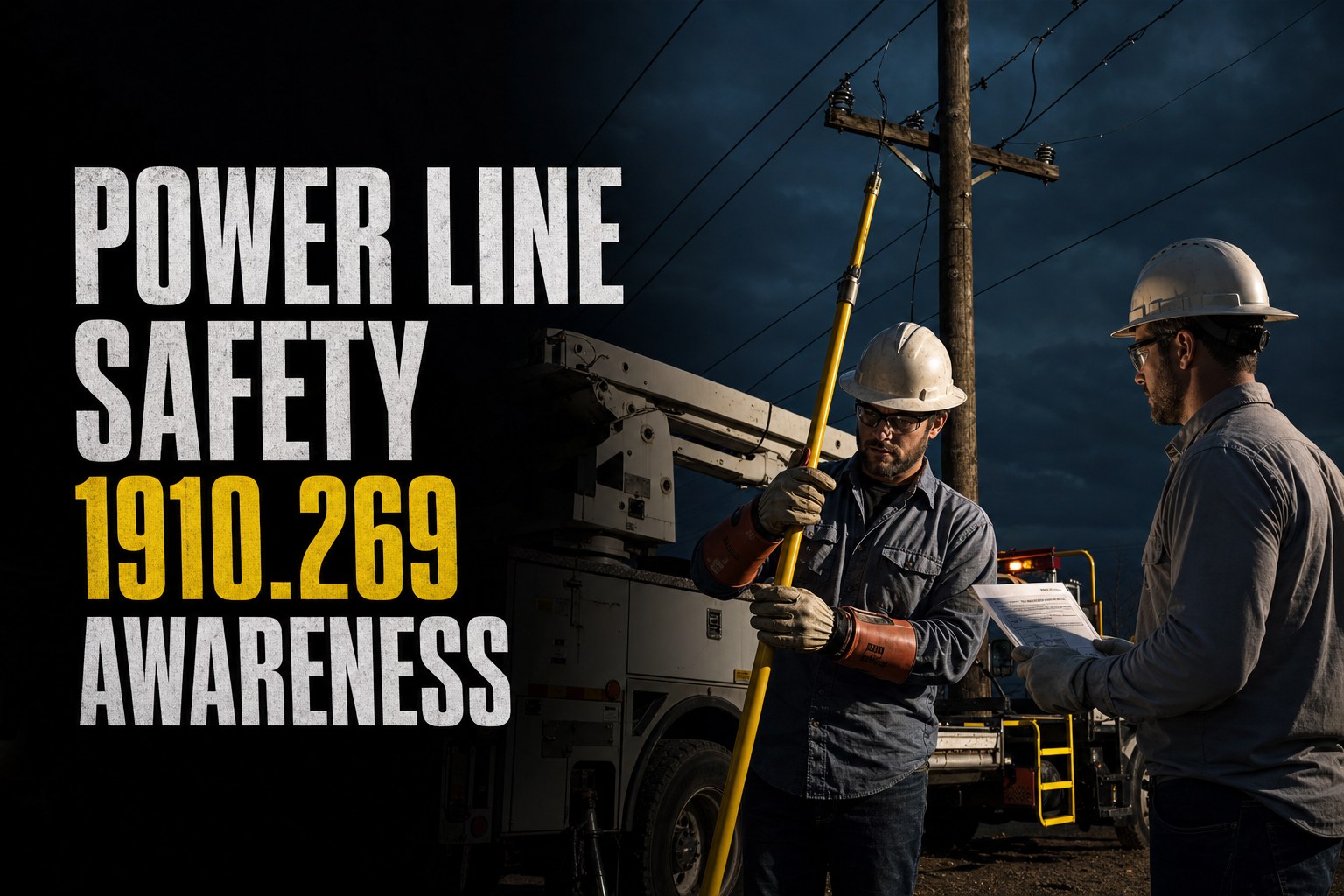
Electric Power Generation, Transmission & Distribution Safety — 29 CFR 1910.269 Awareness
$79 · ~4.5h online · certificate issued same day · valid 2 years
Also read: Breland Homes Faces $115,855 OSHA Penalties After Fatal Trench · Preventing Trench Fatalities: Key Takeaways from NUCA's Safety Month
Controlling the Energy
Hazardous energy control for generation equipment under 1910.269(d), the specific de-energizing and clearance procedure for lines and equipment under (m), and grounding for the protection of employees under (n) are three distinct, sequential requirements — de-energizing alone doesn't make a line safe to work on without the grounding step that follows it.
Fall Protection Looks Different Here
Fall protection on poles and similar structures under 1910.269(g)(2) isn't the same system as tower climbing or construction fall arrest — pole climbing has its own gear and technique considerations, and aerial lifts working near energized lines add a second hazard layer on top of the fall exposure itself.
Special Work Areas
Line-clearance tree trimming near energized conductors, enclosed spaces, and manholes and underground installations each get their own awareness-level attention in the standard, because each introduces a hazard combination (vegetation plus energized lines, confined atmosphere plus electrical equipment) that general electrical safety training doesn't fully cover.
What the Course Covers
BuildRight's Electric Power Generation, Transmission & Distribution Safety course ($79, about 4.5 hours) is awareness-level training in 1910.269: scope versus 1926 Subpart V and 1910.268, qualified-versus-unqualified status and the job briefing, minimum approach distance tables and the controls that allow closer work, arc flash hazard assessment and PPE, hazardous energy control and the de-energizing and grounding sequence, fall protection on poles and aerial lifts, and the special work areas — tree trimming, enclosed spaces and manholes. It closes with emergency response requirements and a joint-use pole scenario that ties the scope question together. It finishes with a final test and a certificate of completion.
This course is currently in final review before publication and isn't open for enrollment yet. Crews working joint-use poles or near power infrastructure should also look at grounding and bonding for telecom sites, which covers the complementary telecom-side grounding work on the same structures.
Frequently Asked Questions
What's the difference between 1910.269 and 1926 Subpart V?
Both cover electric power generation, transmission and distribution work with largely parallel requirements — 1910.269 applies under the general industry framework, while Subpart V applies on construction sites. Which one governs a specific job depends on the nature of the work, not the worker's industry label.
Does 1910.269 apply to telecom technicians?
It can, specifically when work brings a technician within the standard's minimum approach distance of energized power conductors — a common scenario on joint-use poles carrying both power and communication lines, even if the technician's task is purely on the communication side.
What is a minimum approach distance?
A specified distance, based on voltage, that an unqualified person (or a qualified person without additional protective measures) must stay outside of when near exposed energized parts. The standard provides tables setting these distances by voltage level.
Does completing this course qualify someone to work on energized power lines?
No. This is awareness-level training. It explicitly does not make someone a "qualified person" under 1910.269 — that status requires specific demonstrated training and experience the standard itself defines, verified by the employer.
Why does grounding matter even after a line is de-energized?
De-energizing removes the intended power source, but induced or stored voltage can still be present. Grounding for the protection of employees, under 1910.269(n), is a separate required step that follows de-energizing before work is considered safe to begin.

