Tower climbers in the U.S. make a median of $30.54 an hour, or $63,520 a year, according to the latest federal wage data (BLS, May 2025). New hands usually start around $21–$24 an hour. The top 10% earn $49.99 an hour or more — about $104,000 a year — and that's before overtime and per diem.
Those three numbers come from the Bureau of Labor Statistics category that actually covers this job: "Radio, Cellular, and Tower Equipment Installers and Repairers." It's a small trade — BLS counts about 11,140 people in it nationwide — and the spread between the bottom and the top is wide. Where you land in that spread is mostly about what you're trusted to do on the steel, and that's where certifications come in.
Tower climber pay by role
BLS doesn't track job titles like "top hand" or "TTT-1 tech." So we've lined each role up with the part of the federal pay spread it usually sits in. The dollar figures are BLS (May 2025, published 2026). The matching is ours.
- Trainee / ground hand (first year): $21.38–$24.32/hr — $44,460–$50,580/yr. The bottom 10–25% of tower installers.
- Tower technician, TTT-1 level: $24.32–$30.54/hr — $50,580–$63,520/yr. The 25th percentile up to the median.
- Senior tech / TTT-2 / top hand: $30.54–$39.60/hr — $63,520–$82,370/yr. The median up to the 75th percentile.
- Crew lead / foreman: the top 10% of tower installers earn $49.99/hr or more ($103,990/yr). For comparison, first-line supervisors of installers and repairers across all trades have a median of $38.39/hr ($79,860/yr).
- RF / test technician: median $37.59/hr ($78,190/yr) — BLS "electrical and electronic engineering technologists and technicians," the closest category for sweep, PIM and commissioning work.
- Fiber / line tech (for comparison): median $35.73/hr ($74,330/yr) — telecom line installers and repairers.
Three things these numbers leave out. BLS wages don't include overtime premiums or per diem, so a road crew working long weeks takes home more than the base rate shows. They don't cover 1099 contractors at all. That side of the trade can gross well above W2 rates, but you pay self-employment tax, your own insurance, your own gear and the gaps between jobs — our W2 vs 1099 breakdown walks through it. And the market has been rough: carriers squeezed construction budgets hard, and crews reported hourly cuts on some scopes. Treat the top of every band as something you earn, not something you're promised.
Want to check these against real offers? Look at what's posted for tower technician jobs on our job board.
Pay is a ladder of scope, not a meter of years
Look at the gaps. Going from the 25th percentile to the median is about $6 an hour. Median to the 75th is another $9. Nobody crosses those gaps by having a birthday. You cross them when the list of things you can do without someone watching gets longer — when you stop being a hand somebody babysits and become the one who gets sent.
That's where paper comes in. A certification never adds dollars by itself. What it does is document scope: it's the difference between "he says he can" and "here's the record." On a trade where site access runs on checklists and crews get billed to carriers line by line, skill nobody documented doesn't exist as far as the bid sheet is concerned.
The four ways paper moves the number
1. It gets you counted at all. Site checklists are written as crew percentages — RF awareness for everyone, competent climbers for part of the crew, first aid coverage across the roster. A hand without cards can't be counted toward any line, can't be billed to the site, and can get the whole crew turned away at the gate. That's why uncertified workers don't get hired. It isn't prejudice, it's arithmetic.
2. It moves you between tiers. The tiers are scope. What separates a trainee from a technician is the work nobody has to watch: rigging, power, signaling, routine scopes at height. Each of those is cert-gated before it's skill-gated — you don't get the reps until the paper lets you near the work. The competent climber designation is the clearest example: checklists often want a set share of the crew at competent level, which makes every competent climber a ratio-maker.
3. It keeps you working when work thins. In slowdowns, the multi-carded hands stay and the single-purpose ones sit. We wrote about that separately. A cert you bought in a busy month pays off in the slow one.
4. It opens the 1099 door. A contractor has no training department behind them. The only way to walk onto any site, for any carrier, is with a complete, current package you own yourself.
The certs that raise your rate, per dollar
In the order a climber should buy them, with our actual prices and course length:
Fall protection — $30, 30 minutes
The floor. Harness, tie-off, anchorages, inspection, self-rescue awareness. Without it nothing else matters, because you're not going up. Fall Protection Training.
Recommended certification
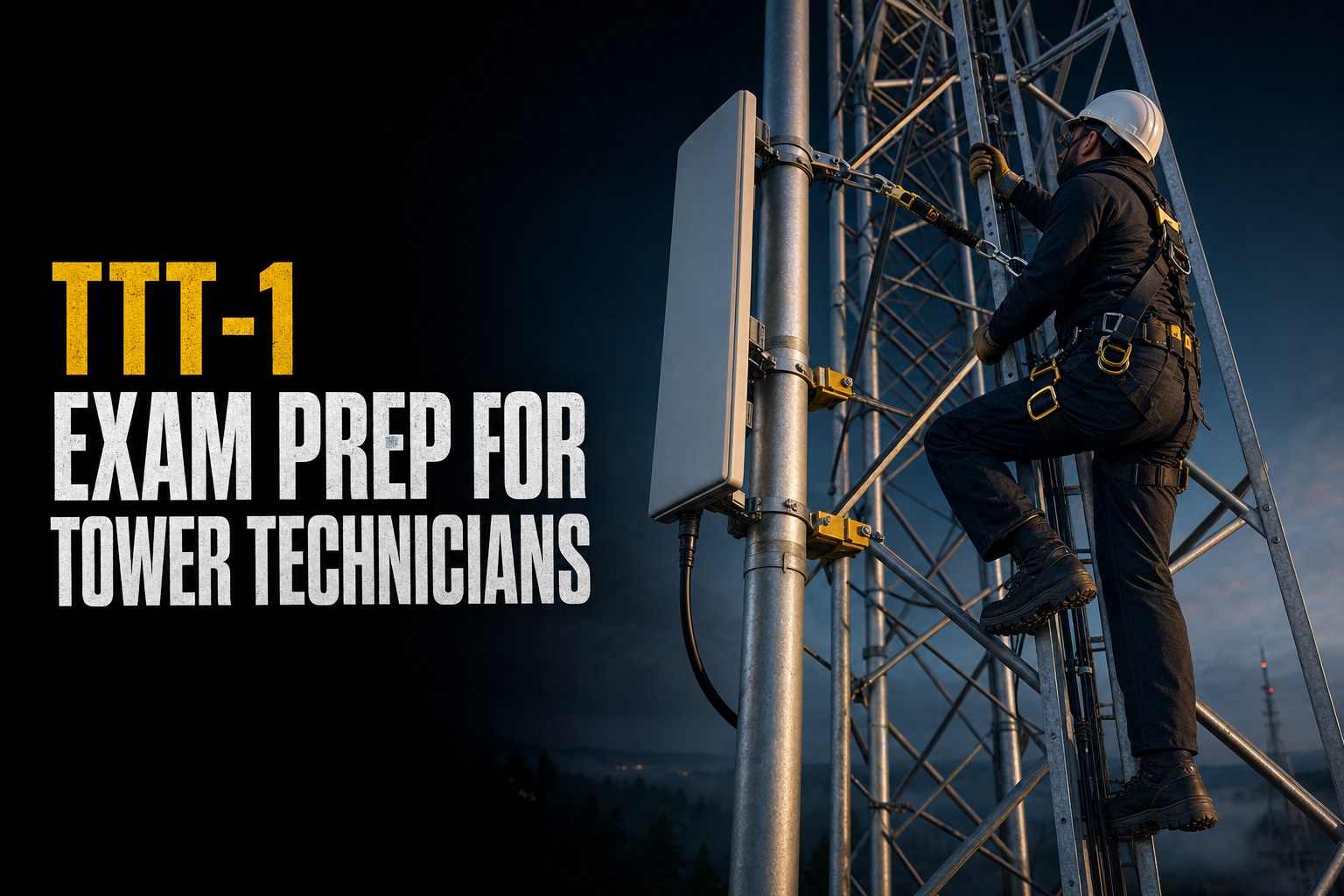
TTT-1 Exam Prep: Telecommunications Tower Technician 1
$120 · ~9h online · certificate issued same day · valid 2 years
Also read: AI-Powered Drone Tower Inspections: Threat or Opportunity for Certified Climbers · Safety Training Budgets Cut 34% as Telecom Contractors Face Worst Margin Compression in a Decade
RF awareness — $49, 1 hour
The card whose absence benches you fastest — checklists commonly want it on the whole crew. What RF safety certification actually is, including why "OSHA RF certified" isn't something anyone can sell you.
First aid / CPR — $40, 1 hour
A thin crew sometimes picks its next mobilization around who holds this card. Standard CPR/AED/First Aid covers the knowledge half; many sites want a hands-on skills check too, so plan for it.
TTT-1 — the credential that names your tier
TTT-1 is the National Wireless Safety Alliance's tower technician certification: a written exam plus a hands-on practical on a real tower. TTT-2 builds on it and certifies you to supervise TTT-1 techs — the paper version of the jump from tech to lead. It's the closest thing this trade has to a title that travels with you from contractor to contractor.
Our TTT-1 Exam Prep covers the written knowledge areas — job planning and drawings, 100% tie-off, rigging limits, structure types, antenna and line work — with 90 scenario questions. 9 hours, $120. It's independent prep, not the NWSA exam itself: you still sit NWSA's written and practical.
Competent climber — the biggest tier lever
The knowledge is trainable online. The designation isn't, and we won't pretend otherwise — it takes documented experience and a practical evaluation. But it's one of the strongest pay levers on this list, because of the crew-ratio math above. Start the paper trail early.
Crane signal ($59, 1 hour) and capstan hoist ($105, 1.5 hours)
Rigging scopes bill better and shortlist tighter. Crane signal training prepares you for the qualification OSHA requires; capstan hoist training covers the hoist tower crews actually use. Both show up on carrier checklists whenever there's a lift plan.
QEW — $99, 3 hours
The least crowded lane. Cell site bases are cabinets, generators and rectifiers — electrical work most climbers can't legally touch. Few hands carry qualified electrical worker training, which is exactly the argument for it. Your employer makes the actual designation; the training half is yours to bring.
Everything above lists at $502 — about 17 hours of coursework. Against the gaps between pay bands, money isn't the limiting factor. Deciding to be the most documented hand on the roster is.
What certs can't do
A certificate won't climb for you, and a gate checker can tell within one shift who trained and who just clicked through. It doesn't replace the practical halves — TTT practicals, competent climber evaluation, signal person qualification — that happen on real steel with real evaluators. And it doesn't guarantee the top of any band: the market, your region and the carrier budget cycle set the weather. What the paper does is make sure that when scope gets handed out, there's no checklist reason it skips you.
The order to buy them in
Year one: fall protection, RF awareness and first aid — the hiring package, $119 total. Then OSHA 10 from an authorized Outreach trainer (which card your job needs is its own question). Once you've got time on steel: TTT-1 prep and the NWSA exam, crane signal and capstan as rigging work shows up, and the competent-climber paper trail. When power work shows up: QEW. And ask your employer before paying for any of it — many will cover training that makes you billable, because your card count is their bid sheet.
Keep everything current, keep it verifiable, and let the ladder do what ladders do. Start with TTT-1 prep or the full catalog, and check tower technician openings for what crews are hiring for this month.
Quick answers
How much does a tower climber make an hour? The median is $30.54 an hour. The bottom 10% make $21.38 or less, the top 10% make $49.99 or more (BLS, May 2025).
How much do tower climbers make a year? The median is $63,520. The middle half of the trade earns between $50,580 and $82,370, and the top 10% make $103,990 or more.
Do tower climbers make more as 1099 contractors? Gross pay can be higher, but taxes, insurance, gear and downtime come out of your pocket. See W2 vs 1099.
Source: U.S. Bureau of Labor Statistics, Occupational Employment and Wage Statistics, May 2025 — occupations 49-2021 (Radio, Cellular, and Tower Equipment Installers and Repairers), 49-1011 (First-Line Supervisors of Mechanics, Installers, and Repairers), 17-3023 (Electrical and Electronic Engineering Technologists and Technicians) and 49-9052 (Telecommunications Line Installers and Repairers). National figures, all industries. Course prices and lengths are current catalog listings.